

Setting up a nursery is one of those projects that sounds wonderfully simple until you actually start shopping. Suddenly there are cribs that convert into four different beds, dedicated changing stations, oversized storage systems, rocking chairs, gliders, bassinets, bookcases, organizers, and perfectly coordinated furniture collections that can make an empty room feel as though it needs far more than you originally imagined.
The good news is that a newborn really doesn’t need a showroom. A well-planned nursery can be comfortable, practical, and beautiful without filling every corner with baby-specific furniture. In fact, choosing fewer pieces carefully often creates a room that works better in everyday life and continues to feel useful long after the newborn stage is over.
The easiest place to begin is with the furniture you know you are likely to use regularly: a safe sleeping space, practical storage, somewhere convenient for diaper changes, and, if you have the room, a comfortable place to sit while feeding or soothing your baby. Everything else can be added gradually once you understand how your family actually uses the room.
Before buying anything, though, remember that appearance should always come after safety. Product requirements can vary between countries, so check the current standards where you live, follow the manufacturer’s assembly and use instructions, and make sure each piece is appropriate for the way you intend to use it.
Start With Safety, Not Style
It is easy to fall in love with a crib because of its color or a dresser because it matches the room perfectly, but nursery furniture needs to do much more than photograph well.
Babies grow quickly into curious toddlers who pull, climb, reach, and explore. Choosing stable, well-made furniture from the beginning can save you from having to rethink the entire room once your baby becomes mobile.
When choosing a crib in the United States, look for a model that complies with current CPSC requirements and applicable safety standards. Older drop-side cribs should not be used simply because they are inexpensive or have been passed down through the family. If you live elsewhere, check the current infant furniture standards in your own country rather than assuming that the same rules apply everywhere.
Tall or heavy furniture deserves just as much attention. Dressers, bookcases, cabinets, and similar pieces that could tip should be secured according to the manufacturer’s instructions, typically with appropriate wall-anchoring hardware.
It may seem unnecessary while your baby is still tiny, but installing those safety measures when you first furnish the room is much easier than scrambling to childproof everything once your little one begins pulling themselves up on furniture.
This is also one reason adaptable furniture is often a better investment than highly specialized nursery pieces. A simple dresser can stay in a child’s bedroom for years, while a dedicated diaper-changing station usually has a much shorter useful life.
Choose Furniture That Can Grow With Your Child
One of the simplest ways to get more value from nursery furniture is to choose pieces that can evolve as your baby grows.
Convertible cribs are a good example. Depending on the model, the crib you use during infancy may later convert into a toddler bed, a daybed, or even part of a full-size bed.
That doesn’t automatically mean the most expensive convertible crib is the smartest choice, though. Before paying extra, check exactly what is included. Some models require separate conversion rails or hardware that must be purchased later. If you are fairly sure you will eventually convert the crib, it may be worth buying those pieces while the model is still current rather than hoping they will remain available several years from now.
Storage can work the same way.
Instead of purchasing a changing table that serves only one purpose, consider a sturdy dresser with enough surface space for a compatible changing setup. Once diapers are no longer part of your daily routine, the changing accessories can be removed and the dresser can continue holding clothing, bedding, toys, or school supplies.
Try thinking of the nursery as the first version of your child’s bedroom rather than a temporary space that will need to be completely replaced after two years.
What Furniture Does a Newborn Nursery Actually Need?
There is no universal furniture list that works for every family. The right setup depends on the size of your home, where your baby will sleep, your budget, and how you prefer to organize your everyday routines.
For many families, the basics are surprisingly simple: an appropriate sleeping space with a suitable mattress, secure clothing storage, and a safe place for diaper changes.
A comfortable chair can also be extremely useful if you expect to spend a lot of time feeding, rocking, reading, or settling your baby in the nursery, but it is not essential for every household.
A separate changing table is one of the easiest pieces to skip. Using a dresser with a suitable changing surface gives you storage directly underneath and allows the furniture to stay useful long after your child is out of diapers. Just make sure the setup you use follows the relevant manufacturer instructions, and never leave a baby unattended on an elevated changing surface.
Storage baskets, shelves, bookcases, side tables, and decorative furniture can all be helpful, but there is very little reason to buy every possible nursery item before the baby arrives.
Start with what you know you will use. After a few weeks of living with the nursery, it will become much clearer whether an additional shelf, basket, lamp, or side table would genuinely make your routine easier.
Choosing the Right Crib
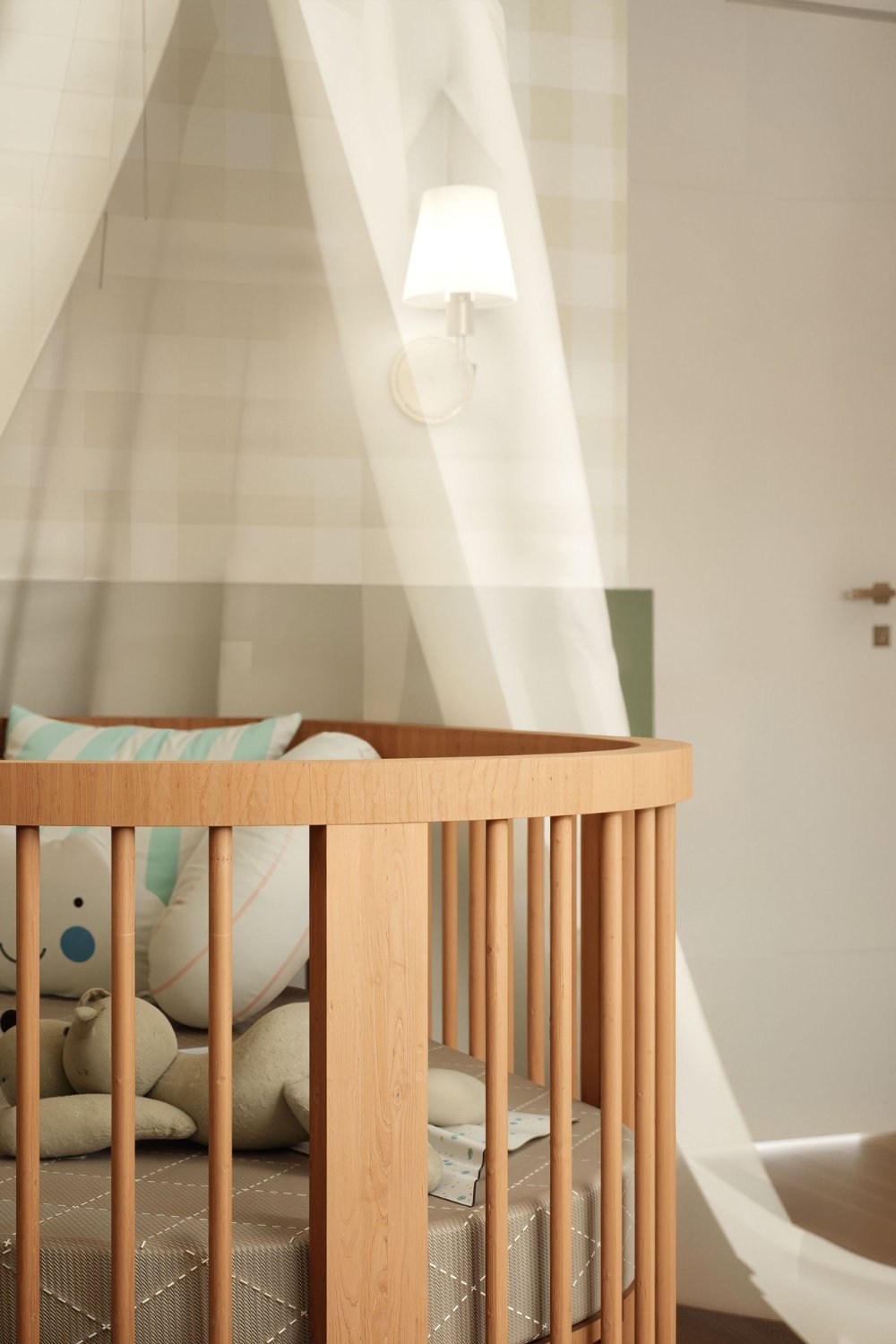
The crib usually becomes the visual anchor of the nursery, which is why many parents start there. Still, the best crib is not necessarily the biggest, trendiest, or most expensive model. It is the one that safely fits your room and suits your plans for the next few years.
A standard full-size crib can work beautifully in a dedicated nursery with enough floor space. In a smaller bedroom, apartment, or shared room, a mini crib or another approved compact sleep solution may make more sense.
Measure the room before ordering. And don’t only measure the space where the crib itself will sit.
Think about whether drawers can open properly, whether you can comfortably walk between furniture, and how the layout will feel once the room contains laundry baskets, toys, feeding supplies, or other everyday clutter.
Convertible cribs can offer excellent long-term value, particularly if you like the idea of keeping the same bed frame as your child grows.
Adjustable mattress heights are another practical feature. During the early months, a higher mattress position can make it easier to place a small baby into the crib. As your child becomes more mobile and begins sitting, pulling up, or standing, the mattress height will need to be adjusted according to the crib manufacturer’s instructions.
Construction matters too. Once assembled, the crib should feel stable, without loose components, missing hardware, improvised repairs, or pieces that do not fit correctly. Always use the hardware supplied or recommended by the manufacturer rather than substituting random parts from a toolbox.
The Mattress Matters Just as Much as the Crib
A beautiful crib is only half of the sleep setup.
For infant sleep, the mattress should be firm, flat, designed for the crib or sleep space you are using, and properly fitted without problematic gaps around the edges. Follow the specifications provided by both the crib and mattress manufacturers to make sure they are compatible.
For a newborn, softer does not mean better.
Infant sleep recommendations emphasize a firm, flat sleeping surface rather than plush cushioning. The mattress should maintain its shape instead of allowing your baby to sink deeply into it.
Keep the sleep space itself simple as well. Decorative pillows, cushions, loose blankets, positioners, and similar soft items may make nursery photographs look cozy, but they do not belong in an infant sleep space. Follow current safe-sleep recommendations from your pediatrician or the relevant health authority where you live.
When shopping, you will come across foam mattresses, innerspring mattresses, and models marketed around features such as breathability, waterproofing, sustainability, or low chemical emissions.
Those details can help you choose between otherwise suitable products, but they should come after the fundamentals: correct sizing, firmness, condition, compatibility, and safety compliance.
Make the Dresser Work Twice as Hard
A good dresser may become one of the hardest-working pieces of furniture in the nursery because it can solve two problems at once: storage and diaper changes.
Choose drawers that open smoothly and provide enough room for the things you expect to use regularly. During the newborn stage, the top drawers might hold diapers, wipes, burp cloths, pajamas, and extra onesies. Later, the same drawers can hold larger clothing, toys, books, or bedding without requiring an entirely new storage system.
If you plan to use the top as a changing area, check the dimensions carefully before purchasing the dresser and make sure the changing product you use is suitable for the setup.
It is also helpful to keep everyday changing supplies close enough that you do not need to turn away or walk across the room mid-change.
As your child grows, however, the way you use the dresser will need to change. Items that seem completely harmless while your baby is a newborn may become tempting objects to grab once they start standing or climbing.
That is another reason why proper furniture anchoring matters from the beginning.
Keep Nursery Storage Simple
Baby belongings have a strange ability to multiply.
A few outfits can become drawers full of onesies, sleepwear, blankets, burp cloths, diapers, toys, books, and gifts surprisingly quickly. Good storage makes the nursery much easier to use, but it does not need to involve a complicated custom organization system.
A dresser can handle clothing and everyday supplies, while baskets or bins can group blankets, toys, and other larger items. Books can live on secure shelving, and smaller supplies can often be kept inside drawers rather than displayed across every surface.
The more flexible the storage, the more likely it is to remain useful.
Neutral baskets, simple shelves, and classic cabinetry can usually move easily from a newborn nursery into a toddler room, while heavily themed baby storage tends to have a shorter lifespan.
Also think ahead about what eventually needs to be kept out of reach. As your child becomes mobile, shelving placement, cords, heavy decorative objects, lamps, and anything stored above or close to the crib should be reconsidered from a safety perspective.
Is a Nursery Chair Worth Buying?
A nursery chair is one of those pieces of furniture that you may technically be able to live without but could end up using every single day.
During the first year, parents can spend a surprising number of hours feeding, rocking, soothing, cuddling, or reading with their baby. If you have the room and the budget, a comfortable chair can make those routines noticeably more pleasant.
You do not necessarily need a chair marketed specifically as nursery furniture.
A supportive armchair or recliner you already own may work perfectly well. Gliders tend to move in a smooth back-and-forth motion, while traditional rocking chairs move along curved runners. Which one feels better is mostly a matter of personal preference.
Comfort matters far more than whether the chair matches the crib.
Look for good back support, comfortable armrests, and a seat that allows you to stand up relatively easily while holding a baby. Easy-to-clean upholstery is another practical advantage because spills, milk, formula, and spit-up have a way of reaching almost everything in a nursery.
Scale matters too. A huge recliner might feel luxurious in a furniture showroom but completely overwhelm a small room.
Measure the chair itself, but also consider the extra space required for rocking, gliding, or reclining.
How to Furnish a Nursery Without Overspending
Nursery shopping can become expensive very quickly because so many products are marketed as things responsible parents are supposed to have.
The simplest way to control the budget is to separate genuine everyday function from decoration.
Spend thoughtfully on products where quality, condition, and safety matter most. Your baby’s sleep space deserves careful consideration, and furniture that may remain in the room for many years can justify a larger share of the budget if the construction and durability are genuinely better.
Decor is where you can be much more flexible.
Artwork, baskets, curtains, lamps, rugs, decorative accessories, and other styling pieces can often be found inexpensively, reused from another room, purchased secondhand where appropriate, or added over time.
There is also no rule saying every piece in the nursery has to belong to the same matching furniture collection.
A simple crib paired with a dresser you already own and a comfortable chair from another room can create a space that feels more personal—and often much less like a furniture showroom.
Before buying something, ask yourself a simple question: Will this make everyday life with the baby easier, safer, or more comfortable?
If the answer is no, there is probably no urgent reason to buy it before your baby arrives.
Be More Cautious With Secondhand Baby Furniture
Secondhand furniture can be a great way to reduce the cost of furnishing a nursery, but not every baby product is equally suitable to buy used.
For items with important safety requirements, particularly cribs and sleep products, check the model, manufacturing information, applicable standards, recall history, and manufacturer instructions before deciding to use them.
Avoid products with missing labels, unknown origins, loose hardware, structural damage, modifications, missing parts, or improvised repairs.
In the United States, older cribs manufactured before stricter federal requirements took effect in 2011 deserve particular caution. A crib should never be assumed safe simply because it looks sturdy or because another family used it without problems.
Dressers, shelving, and chairs may be easier to evaluate secondhand, but they still deserve a careful inspection.
Check joints, drawers, stability, upholstery, hardware, and whether the piece can be properly secured in your home. A bargain is only a bargain if the item is still appropriate and safe to use.
Build the Nursery Around Real Life
The most useful nurseries are designed around ordinary moments rather than photographs.
Imagine changing a diaper when you have barely slept, reaching for fresh pajamas while holding your baby, searching for a burp cloth in the dark, or sitting through a long nighttime feeding. Furniture placement should make those moments easier.
Keep everyday supplies near the places where you use them and leave enough open floor space to move comfortably. Try not to fill every empty corner simply because the room looks unfinished.
That open space may become surprisingly valuable later for tummy time, crawling, play, and eventually the ever-growing collection of toys that seems to appear overnight.
It can also help to finish the nursery gradually instead of treating your due date as a deadline for every decorative decision.
Once your baby arrives, you may discover that the storage arrangement you imagined is inconvenient, that you prefer feeding somewhere else, or that an extra laundry basket would be far more useful than the decorative side table you planned to buy.
There is nothing wrong with letting the room evolve with your family.
The Bottom Line
A beautiful nursery does not need a long furniture list.
Start with a safe and appropriate sleeping space, practical storage, a workable diaper-changing setup, and whatever seating makes sense for your home. Choose pieces that are sturdy, useful, and adaptable enough to remain part of the room as your baby becomes a toddler and eventually a child.
Prioritize safety over trends, secure furniture correctly, follow manufacturer instructions, check current product standards and recalls where relevant, and be selective about secondhand items.
Once those basics are handled, you can focus on the colors, artwork, books, fabrics, baskets, and personal details that make the room feel warm and uniquely yours.
Most importantly, give yourself permission not to have everything figured out before your newborn comes home. Your baby does not need a perfectly styled room filled with every product on a registry checklist.
A safe, comfortable space and the people who care for them are a much better place to start.
Safety Note
This article is intended as general information and inspiration for planning a nursery and should not be treated as a substitute for current product-safety guidance or professional advice. Nursery furniture and infant sleep recommendations can change, and regulations differ by country.
Always follow the instructions and safety warnings provided by the manufacturer of each product, check applicable government safety standards and recall information, and consult your pediatrician or another qualified healthcare professional if you have questions about your baby’s sleep environment or safety.





Leave a Reply