
After nearly a decade of white marble, white cabinets and squeaky-clean subway tile, kitchens are getting their personality back. Dark cottagecore kitchens are the clearest sign of it: deep green or charcoal cabinets, worn wood, vintage dishes, dried herbs and warm light. Searches for dark cottagecore kitchen ideas jumped 915% in Pinterest’s Spring 2026 trend report, making it one of the fastest-growing home looks on the platform.
Below: why the trend took off, how to keep a dark kitchen from feeling like a cave, the mistakes that make it heavy, the paint and lighting details designers rely on, how to make it work in a small kitchen or a rental, and five affordable swaps to start with.
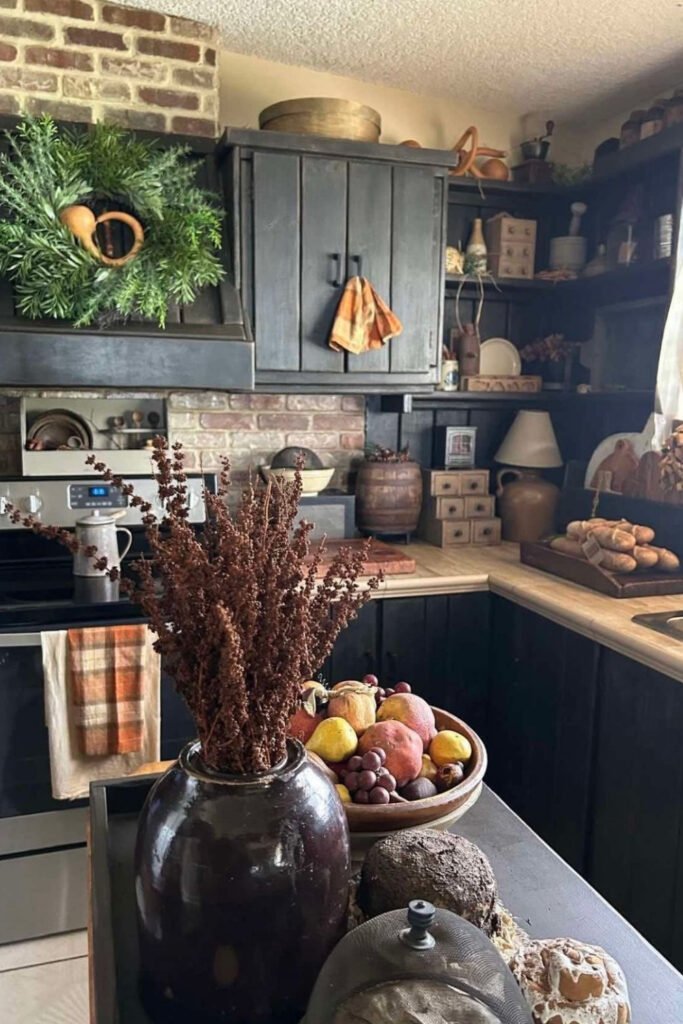
Why dark cottagecore kitchens are everywhere right now
The short answer: people are tired of living in a catalog. The longer answer is a little more interesting.
Comfort over status
Pinterest’s Spring 2026 report, based on activity from more than 600 million monthly users, framed the year as a move toward comfort over status and personal taste over strict design rules. Searches for “my room, my rules” rose 415% year over year.
Younger homeowners and renters are leading it. Instead of waiting for a big renovation budget, they’re painting cabinets, swapping hardware and layering in thrifted finds to make the kitchen feel like theirs now. Pinterest Predicts has a reported 88% accuracy rate over the past six years, so a jump this size usually means a change already under way rather than a one-season fad.
Nostalgia with an edge
Classic cottagecore (soft pastels, gingham curtains, wildflowers in a jug) has been around for years. Dark cottagecore is its moodier, more grown-up cousin. Sunny yellow and cream give way to forest green, charcoal, navy and plum, and bright open shelves give way to warm wood and candlelight. It borrows a little from dark academia and the “witchy kitchen” look, with apothecary jars and drying herbs.
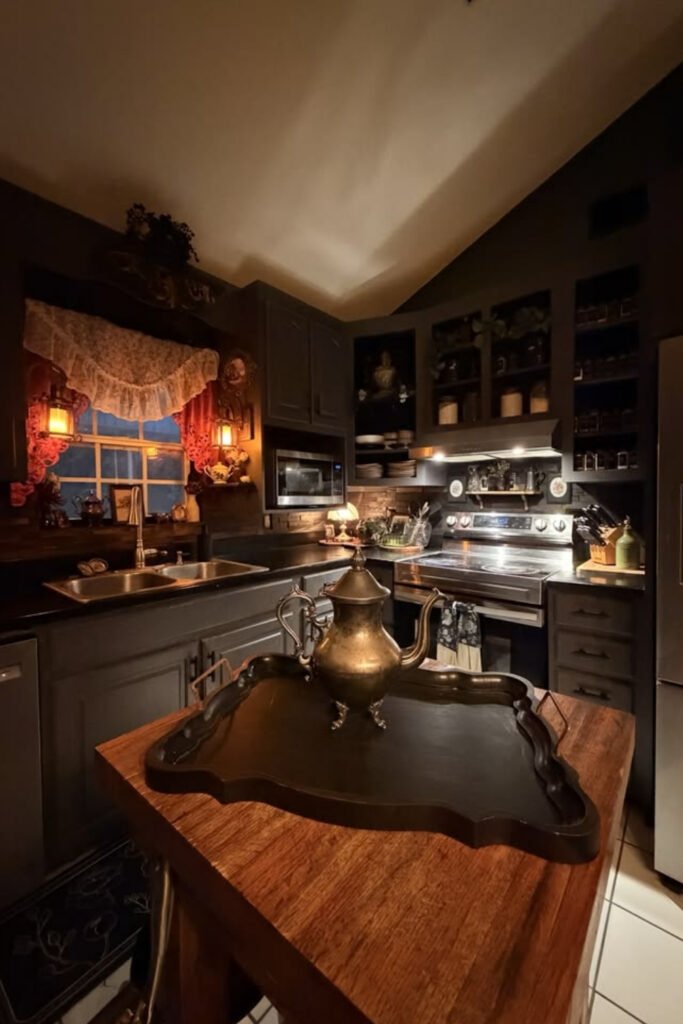
Related looks are rising at the same time, from aubergine kitchens to grandmacore kitchens. What they share is a kitchen that looks collected over years and actually lived in.
How to keep a dark kitchen warm, not cave-like
This is the part everyone worries about. The moody photos look great, but nobody wants a kitchen that feels heavy and gloomy at 7 a.m. These two principles make the difference.
The three-tier color rule
Think in three layers: dark walls or cabinets, warm midtones in the middle (wood counters, brass hardware, natural textures), and a light ceiling or backsplash on top. One Home Therapy describes this three-tier approach as the way to keep a moody kitchen feeling open.
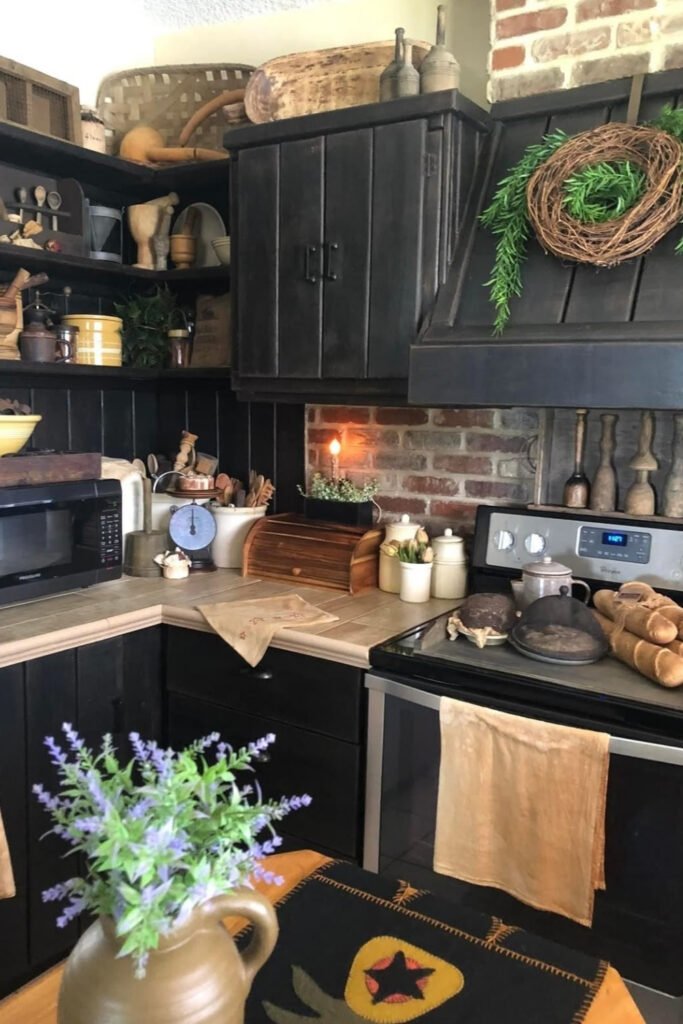
Two-tone cabinets are one of the easiest ways to apply it. Paint the lower cabinets a deep shade such as hunter green or charcoal and keep the uppers cream, warm white or natural wood, or replace them with open shelves. Eye level stays light, and the dark color grounds the room instead of taking it over.
A cream or white backsplash, especially one with handmade texture like zellige or slightly uneven subway tile, bounces light back into the room. You keep the mood without losing the sense of space.
Lighting does more than paint
Dark cabinets absorb light, so a dark kitchen needs a lighting plan that works roughly twice as hard as a white one. A single ceiling fixture is never enough.
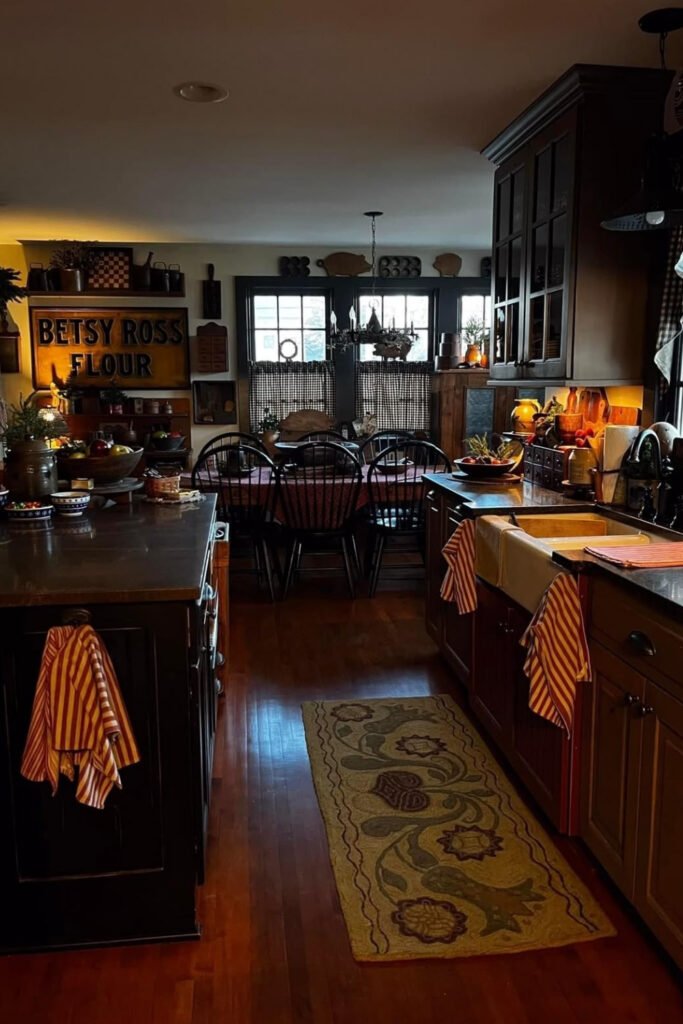
Layer it: under-cabinet LED strips for the work surfaces, warm pendants over the island or table, and a decorative layer such as wall sconces, a small table lamp on the counter or candles in mismatched holders. Use warm bulbs around 2700K. Cool white LEDs make a dark kitchen look flat and clinical, while warm light brings out the depth in green and navy paint. Dimmers on the pendants let the room go from bright for cooking to soft for dinner. Lit candles look lovely on a windowsill or table, but keep them well away from dried herbs, curtains and open shelves, or use good-quality flameless candles for the same glow.
3 dark kitchen mistakes that go wrong fast
Not every dark kitchen turns out dreamy. These three mistakes are behind most of the ones that feel oppressive.
Going dark on every surface
Dark uppers, dark lowers, dark walls, dark backsplash and dark floors leave the eye nowhere to rest, and the room seems to shrink. You need contrast somewhere: a light countertop, a bright backsplash or open shelves with pale ceramics and glass. Treat the dark color like seasoning. Enough to set the mood, not so much that it’s all you taste.
Relying on one overhead light
One ceiling fixture plus dark cabinets creates deep shadows under the uppers, in corners and along the counters. Light the room at three levels (overhead, mid-height and under-cabinet), and the dead zones disappear.
Forgetting texture
A dark kitchen with only smooth, flat surfaces looks lifeless. The character comes from layered textures: rough wood, woven baskets, hand-thrown pottery, wrought iron hooks, linen towels and hammered copper.
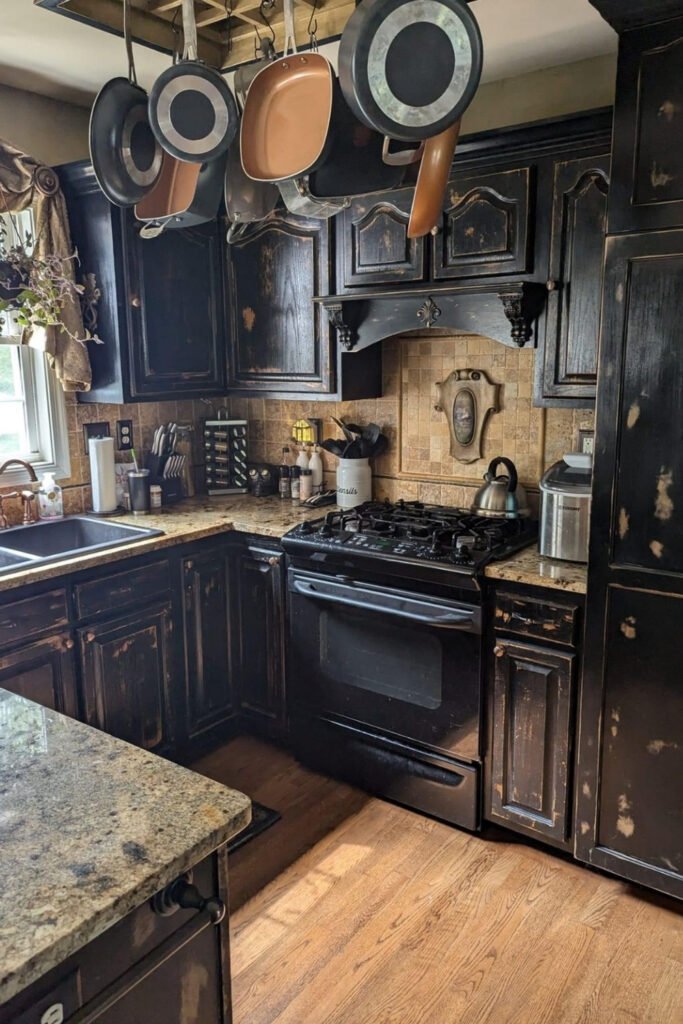
Copper pots hanging above the stove, a wooden spoon jar and a linen towel over the oven handle add warmth and a bit of shine against dark paint. These details are what make the room feel like a cottage instead of just a dark kitchen.
The designer details behind dark cottagecore kitchens
Warm undertones over cool ones
Two charcoals can feel completely different. One with brown or green undertones feels warm. One with blue or gray undertones feels cold and industrial. Hunker’s guide to the trend points to colors found in nature: hunter green, deep navy, midnight blue, plum and burgundy. Even near-black works when it has a warm, earthy base.
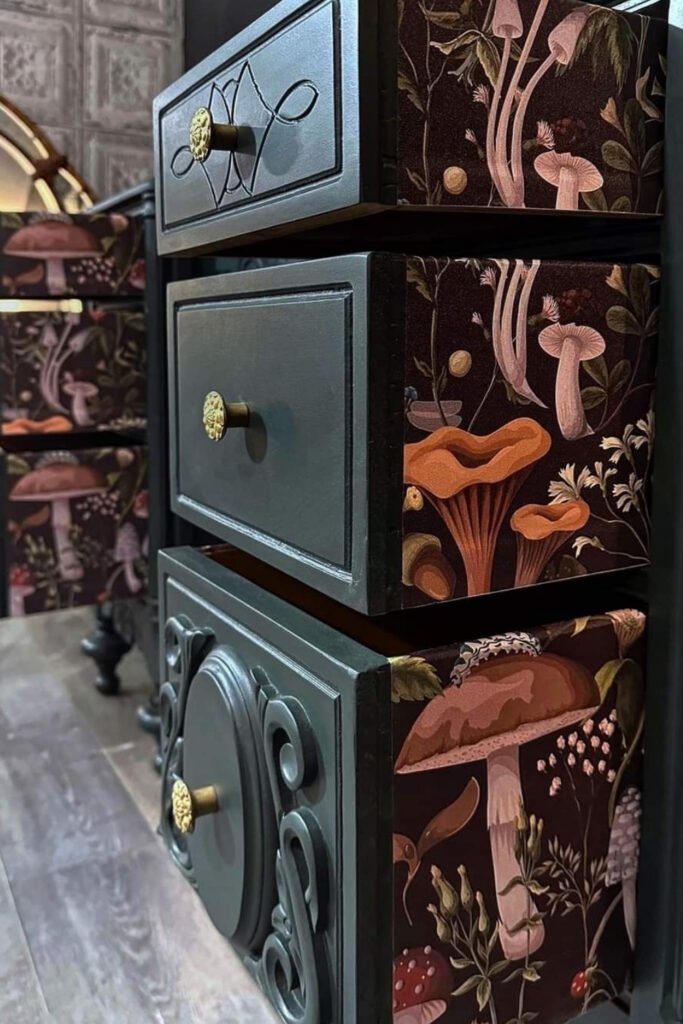
Before committing, paint a large swatch on an actual cabinet door, or a big sample board, and live with it for a week. The same color looks very different at 7 a.m. and under evening lamps. A hand-painted detail, like small mushrooms, ferns or vines on a cabinet door, adds the storybook touch that makes cottagecore what it is, and it’s easy to paint over later. If you’re still choosing cabinet styles, this guide to choosing kitchen cabinets covers materials and finishes.
Matte over gloss
High-gloss dark paint shows every fingerprint and reflects light in hard streaks. A matte or eggshell finish softens the light and gives cabinets a handmade feel. For kitchens, choose a scrubbable or cabinet-grade paint, since flat wall paint marks too easily.
How to paint kitchen cabinets so the color lasts
Painted cabinets are the heart of this look, and they get more wear than almost any other painted surface in the house. The prep decides how long the finish lasts.
Take the doors and drawer fronts off and label each one with painter’s tape, so they go back in the right place. Clean every surface with a degreaser, since years of cooking leave a film that paint won’t stick to. Sand lightly with fine-grit sandpaper to dull the old finish, wipe off the dust, then apply a bonding primer. Two thin coats of a cabinet-grade enamel, with a light sanding between coats, give a smoother and tougher finish than one thick coat.
Then be patient. Most cabinet paints feel dry within hours but need a week or more to cure fully, so rehang the doors gently and avoid scrubbing them for the first couple of weeks. Rented spray equipment speeds things up on a full kitchen, but a good synthetic brush and a small foam roller give a very respectable finish on a smaller job.
Floors, rugs and textiles
Floors matter more in a dark kitchen than in a white one. Warm wood or wood-look floors keep the room from feeling cold, while very dark floors under dark cabinets make the whole space sink. If you’re stuck with a plain or cool-toned floor, a vintage-style runner in faded red, rust or green warms it up and softens the area in front of the sink and stove.
Textiles do a lot of the softening too. Café curtains in linen or a small floral print, a gathered skirt under the sink in place of a cabinet door, and a stack of striped or checked tea towels on display all add the handmade layer that makes the room feel like a cottage. Keep the fabrics in muted, earthy tones so they sit comfortably next to the dark paint.
Mistakes with the finishing touches
Skipping wood
Wood is the backbone of a cottagecore kitchen, and in a dark one it matters even more. A butcher block counter, a wood island top or open wood shelves give dark cabinets the warmth they need. Wood also ages well: knife marks and coffee rings add character instead of ruining it. Oil butcher block every few weeks at first, then monthly, so it doesn’t dry out or crack.
Checkerboard tile is another counter or backsplash option that fits the vintage look. Small square tiles in cream and green or cream and black next to a farmhouse sink feel straight out of an old cottage, though grout lines need sealing and a little more scrubbing than solid surfaces.
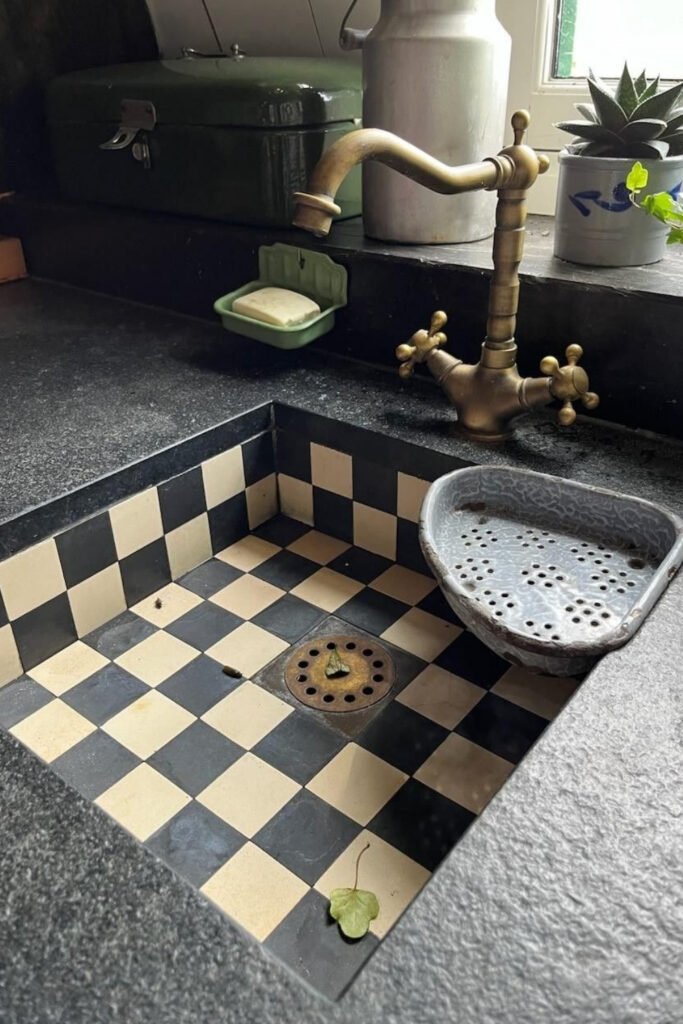
If replacing counters isn’t practical, a collection of wooden cutting boards leaning against the backsplash or a reclaimed wood island top still brings in that warmth.
Hiding everything behind doors
This look thrives on display. Open shelves of vintage ceramics, dried herbs hanging from hooks, cast iron on the stove and spices in apothecary jars make the kitchen feel alive. You don’t need to show everything, just a few chosen pieces that look collected over time.
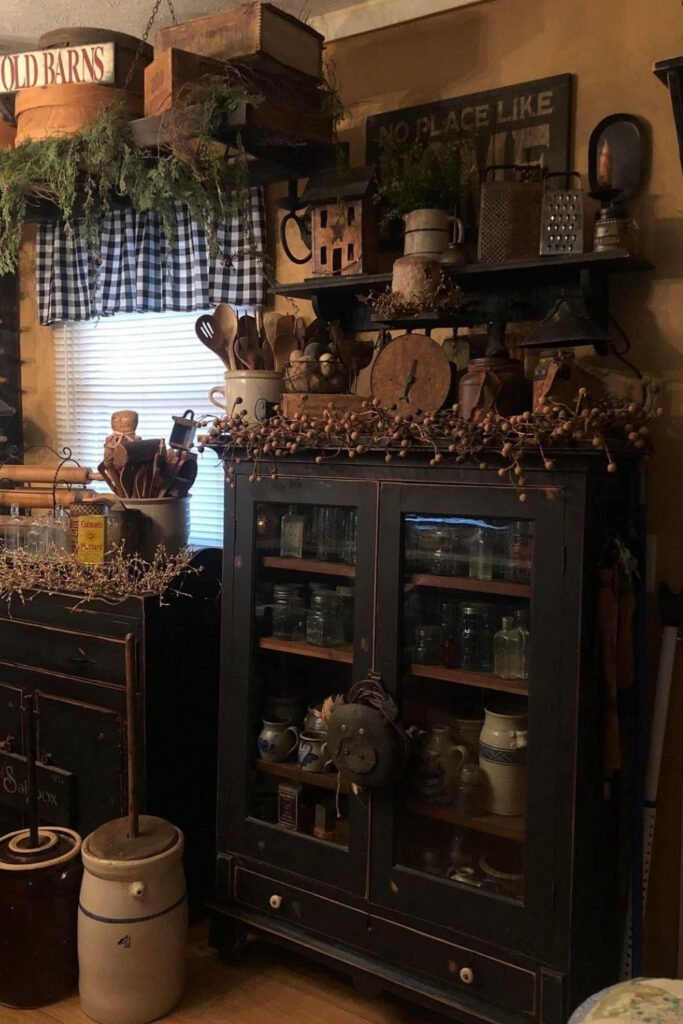
A dark hutch or dresser holds dishes and linens and doubles as display space, and cast-iron pans on hooks along a wall or the back of a door are practical as well as pretty.
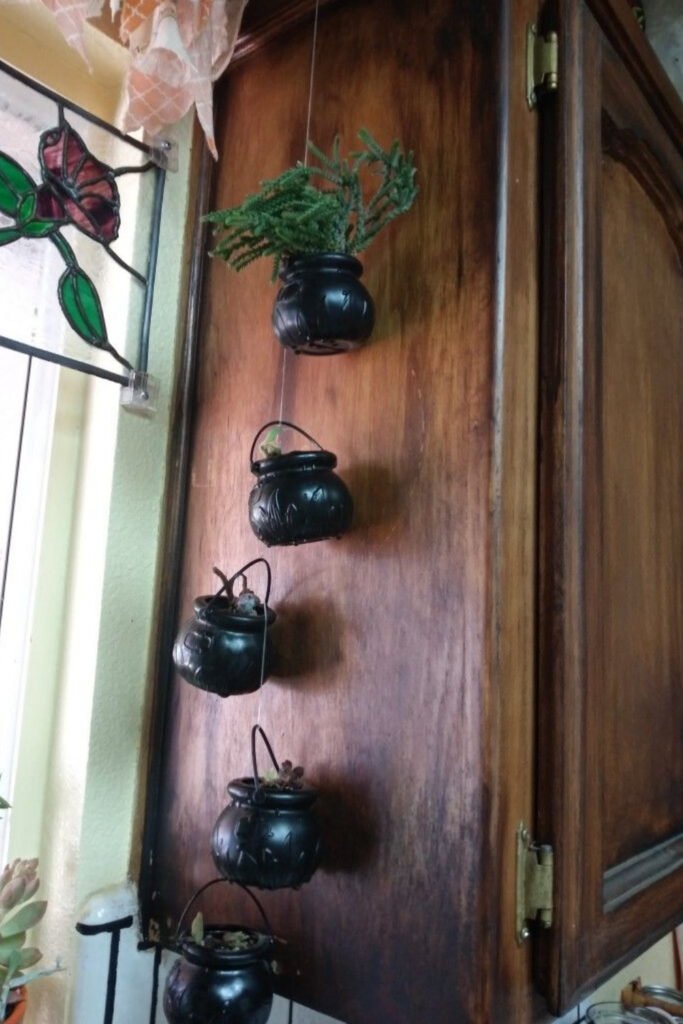
Dark cottagecore in a small kitchen
Small kitchens and dark colors sound like a risky pair, but with the right balance a compact dark kitchen can feel more intimate than a cramped white one.
Does a dark kitchen look smaller?
Not necessarily. The problem is dark color everywhere with no contrast. Balance dark cabinets with a lighter counter, a bright backsplash and warm layered lighting, and a small kitchen feels snug rather than cramped. Glass-front doors, polished brass and a small mirror opposite a window bounce light around, and those small choices add up.
Swap the uppers for open shelves
Removing upper cabinet doors, or the uppers entirely, opens up the space above eye level and gives you a place to display handmade mugs, stacked plates and herb jars. Dark lower cabinets ground the room while the open shelves keep it airy. Style shelves loosely: everyday plates and bowls you actually use, a few pieces of vintage pottery, one plant and a jar or two of dried goods. Leave some empty space on each shelf, and keep the heaviest stacks closest to the brackets. Open shelves collect a little more dust and kitchen grease than closed cabinets, so items in daily use stay cleanest because they get washed anyway.
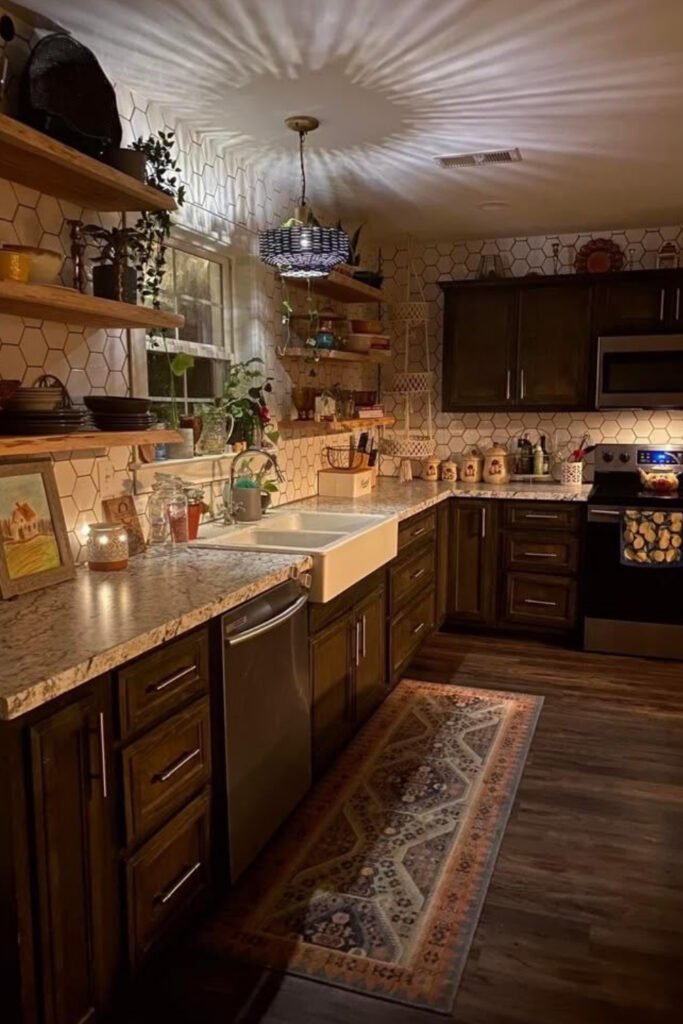
A runner rug in a faded pattern softens the floor in a narrow galley and hides crumbs. If you prefer a lighter palette, these sage green and cream kitchens use the same tricks to keep small spaces open.
Making it work in a rental
Renting doesn’t mean living with a boring kitchen. Many dark cottagecore ideas are completely reversible.
Renter-friendly swaps
Peel-and-stick wallpaper in a dark floral or botanical print changes a wall without paint, and removable tile stickers can cover a plain backsplash. A tension rod across the window with herb bundles tied on with twine adds instant cottage feel. If the lease allows, unscrew the upper doors, store them safely, and put them back when you move out. Always check the lease before painting cabinets.
Decor that moves with you
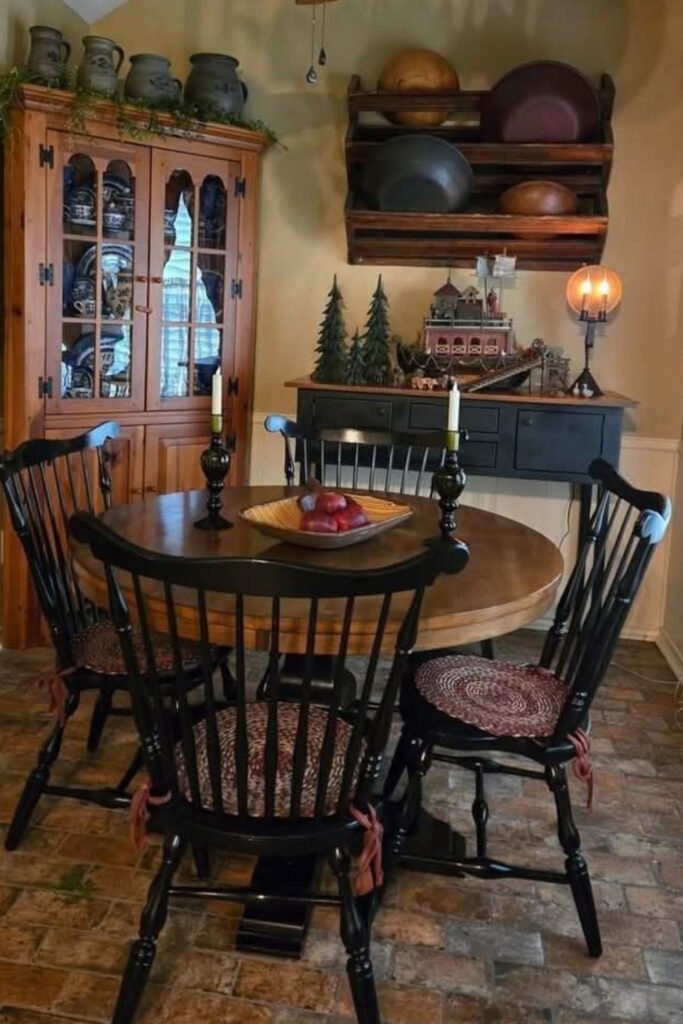
Much of this look lives in portable pieces: amber glass jars for spices, thrifted ceramics, brass or iron candle holders, a dark patterned runner, linen towels in muted tones and a vintage hutch or small dining set. You’re building a collection, not a renovation, and every piece comes with you to the next place.
5 affordable swaps to start with
1. Paint the lower cabinets. A can of cabinet paint in deep green, charcoal or navy with warm undertones is the biggest single change. Clean, degrease, sand lightly and prime first, or the paint won’t hold up to kitchen use.
2. Change the hardware. Brass cup pulls, antique bronze knobs or wrought iron handles change the mood in about an hour and cost little.
3. Add warm under-cabinet lights. Plug-in, stick-on 2700K LED strips fix the shadow problem in an afternoon.
4. Shop thrift stores. Hand-painted mugs, old spice tins, wooden boards, cast-iron trivets and mismatched floral plates set the look on a couple of open shelves.
5. Hang herbs and add plants. Dried lavender, rosemary and eucalyptus from hooks or a rack, fresh herbs on the windowsill, and a trailing pothos on top of the cabinets bring green against dark paint.
Keeping dark cabinets clean
Dark matte paint hides grease splatters better than white but shows dust, flour and water spots more. A soft microfiber cloth and a little warm water with a drop of dish soap handle most of it; skip abrasive sponges and harsh cleaners, which leave shiny patches on a matte finish. Wipe handles and the area around the trash pull-out more often, since that’s where fingerprints build up first. A small touch-up jar of the cabinet paint, saved from the original can, fixes chips in minutes.
A trend with staying power
Dark cottagecore isn’t just a seasonal Pinterest phase. It reflects something people want from home: rooms that feel personal, collected and lived in rather than pristine. My take: the best part is how little it takes to start. Paint one set of cabinets, swap the hardware, hang a bundle of herbs, and the kitchen already feels different.
Pick one swap from this list and try it this weekend. Which one are you starting with? Tell me in the comments.
Leave a Reply