

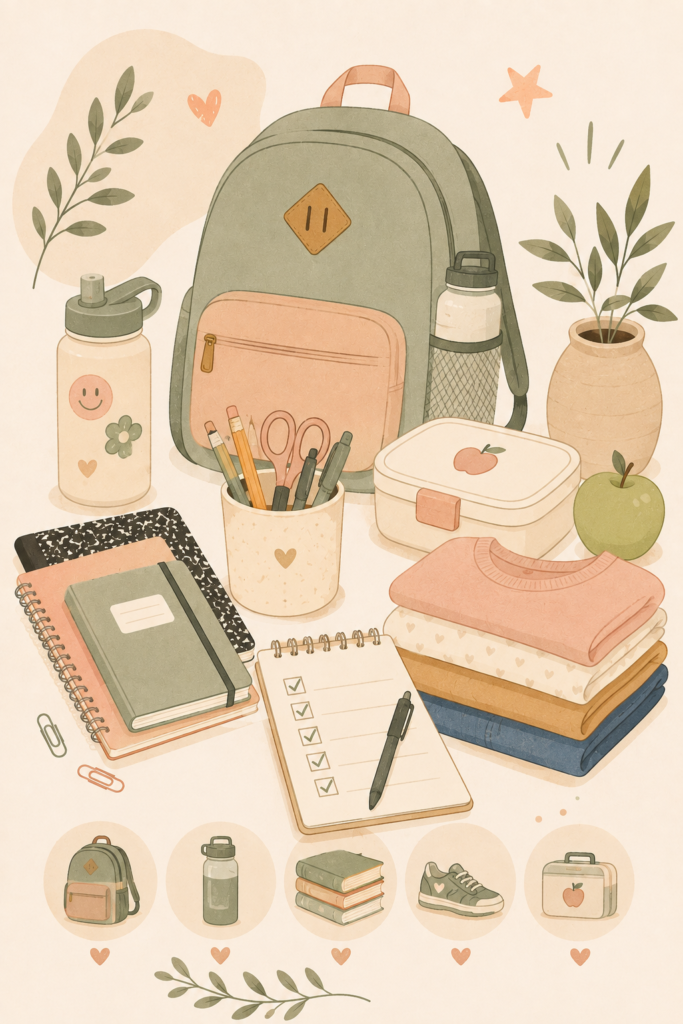
There are exactly three lists you need before school starts, and the store only knows about one of them.
That’s the whole problem with back to school prep. You walk in holding the teacher’s list, you walk out with a cart, and by June half of it is unopened in a drawer. Meanwhile the things nobody put on a list, the spare socks, the second ice pack, the label maker, are the ones you actually needed in week two.
So this guide is the other two lists plus the one you were handed. Supply lists for every stage from preschool through college, ten lunches that come home empty, five first-day photo setups you can pull off in the four minutes you’ll realistically have, and a four-week countdown so none of it lands on you at once.
No filler. Every section goes straight into the specifics.
What You Actually Need vs. What the Store Wants You to Buy
Three lists, and you shop them separately.
The teacher’s list is non-negotiable and usually communal. Half of what’s on it (tissues, wipes, ziplocs, glue sticks by the dozen) gets pooled for the whole class, which is why the quantities look absurd. Buy the cheapest acceptable version of these. Nobody is grading the brand of tissue.
The home list is the one nobody hands you: a labeled water bottle, a second set of everything that gets lost, a spare outfit for the little ones, a homework station that isn’t the kitchen table at dinnertime. This is where the money is worth spending, because these are the things that cause the actual friction.
The skip list is what I buy every year out of momentum and never use. The 64-pack of markers when the list said 24. The fancy pencil case that doesn’t fit in the desk.
Three notebooks in a subject that turned out to be all digital. (I have done all three of these. More than once.)
Shop list one at the store. Shop list two from your own house first. Ignore list three entirely.
One more thing before you buy anything: go through last year’s supplies. Not a quick glance, an actual dig through the drawer and the old backpack. Most families are sitting on half a list already, and the twenty minutes it takes to find out is the highest-value twenty minutes in this whole guide.
The Supply List, Stage by Stage
What’s on the list, the one thing parents forget, and the one thing to skip.
Preschool
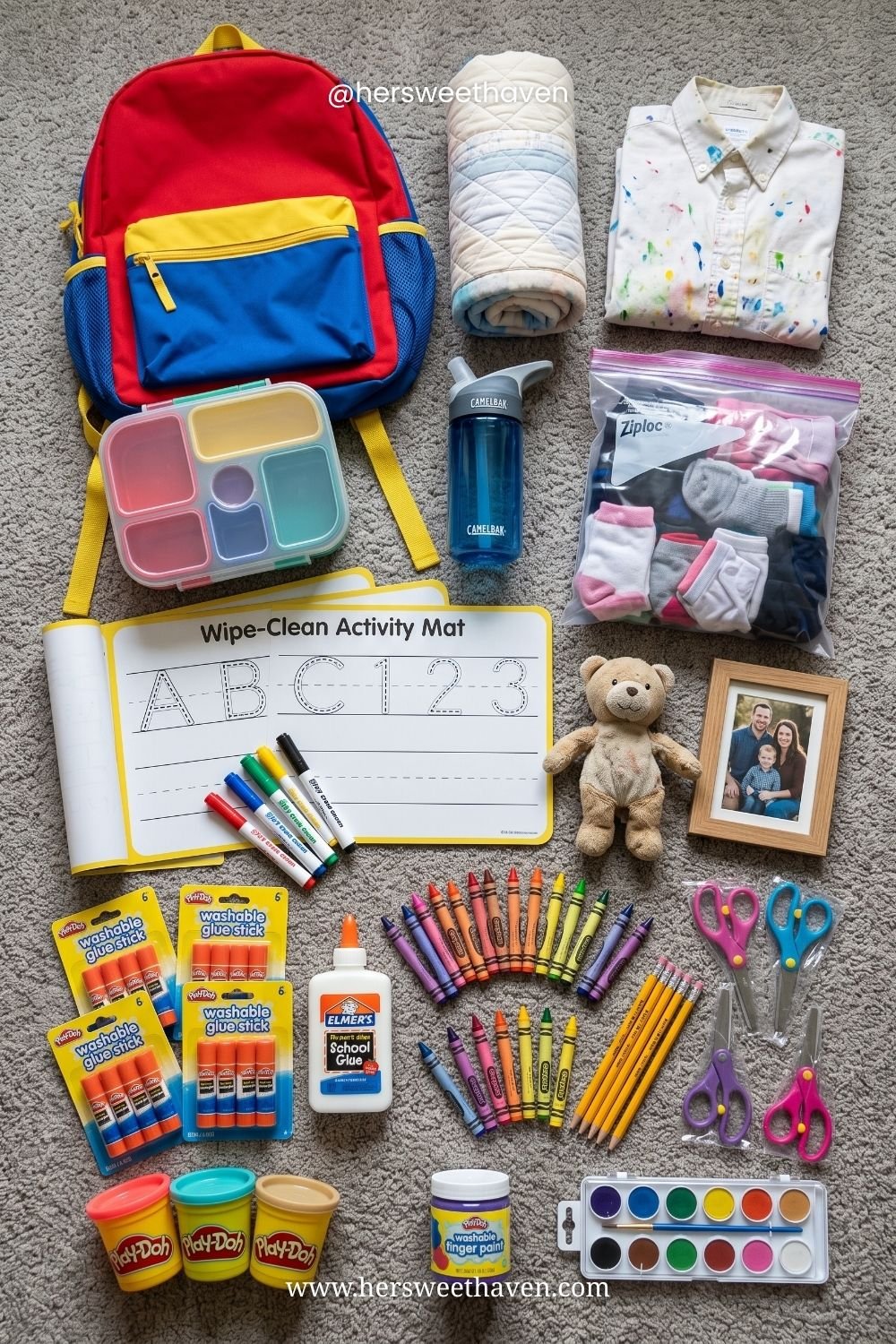
The list is short and mostly about mess and comfort: washable glue sticks, jumbo crayons, safety scissors, washable finger paint, play dough, a wipe-clean letter mat, watercolors.
What parents forget: the spare clothes bag. Two full changes, including socks, in a labeled ziploc. Also a nap mat if they do rest time, a paint shirt (an old button-down works), and a small framed family photo for the cubby, which sounds sentimental and genuinely helps with drop-off.
Skip: anything sharp, anything with small parts, and character-branded supplies. They cost double and get lost at exactly the same rate.
Label everything before it leaves your house. Every jacket, every water bottle, every shoe. The lost-and-found bin at a preschool is a humbling place.
Elementary
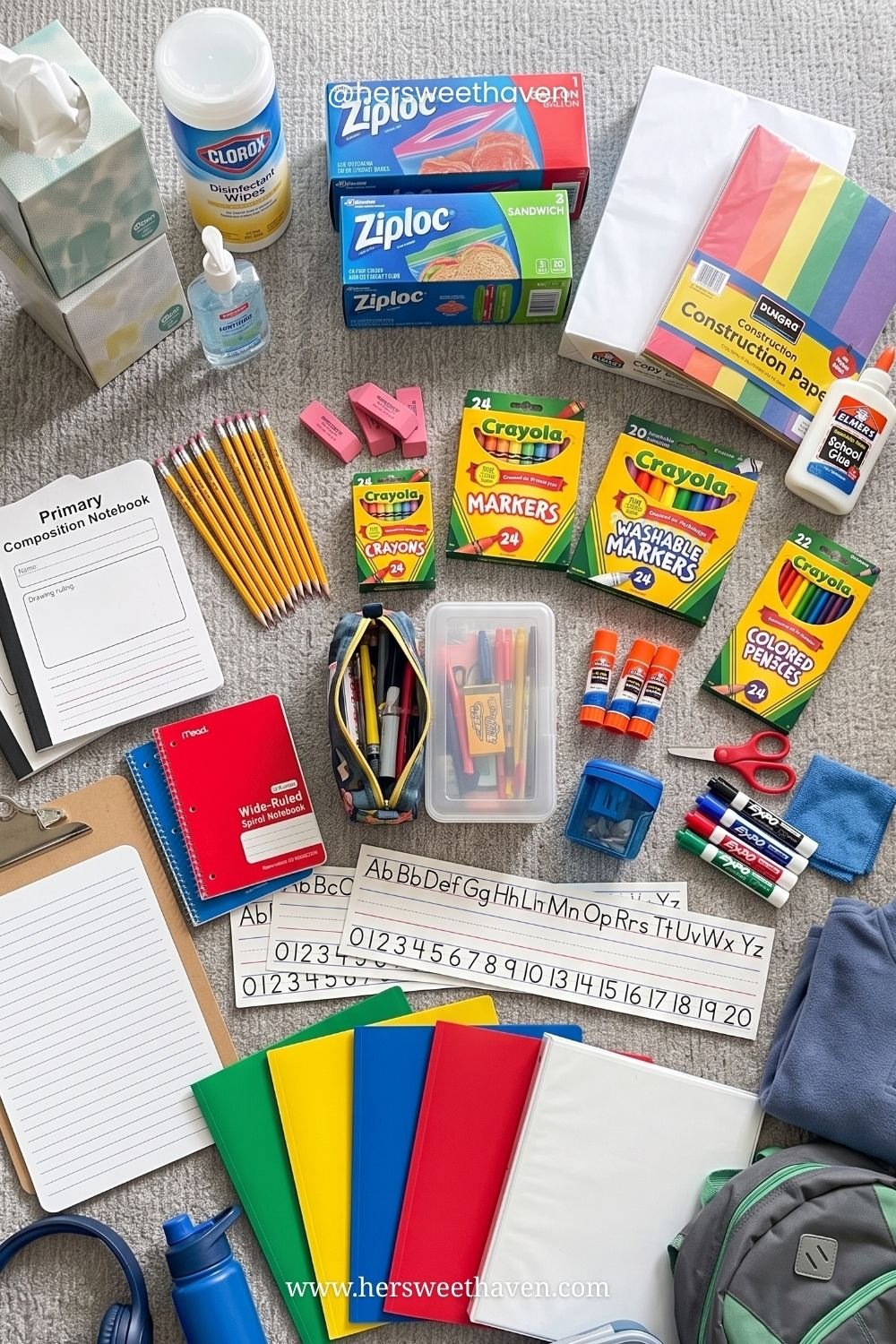
This is the peak-quantity year. Composition notebooks, wide-ruled spirals, a clipboard, folders in specific colors (the colors matter, teachers use them for subjects), 24-count crayons, washable markers, colored pencils, glue sticks, pencils, pink erasers, a sharpener, dry-erase markers plus a cloth, handwriting strips, construction paper, and the communal tissues and wipes.
What parents forget: headphones. Almost every elementary classroom now uses tablets for part of the day, and the ones the school provides are shared and grim. A cheap over-ear pair with their name on it, in a labeled bag, is the single most appreciated thing you can send.
Skip: the mechanical pencils. They break, the lead goes everywhere, and most teachers ask for standard yellow ones anyway.
This is also the age where a real homework spot starts to matter, and a study table that actually fits the room beats the kitchen counter by a mile.
Middle School
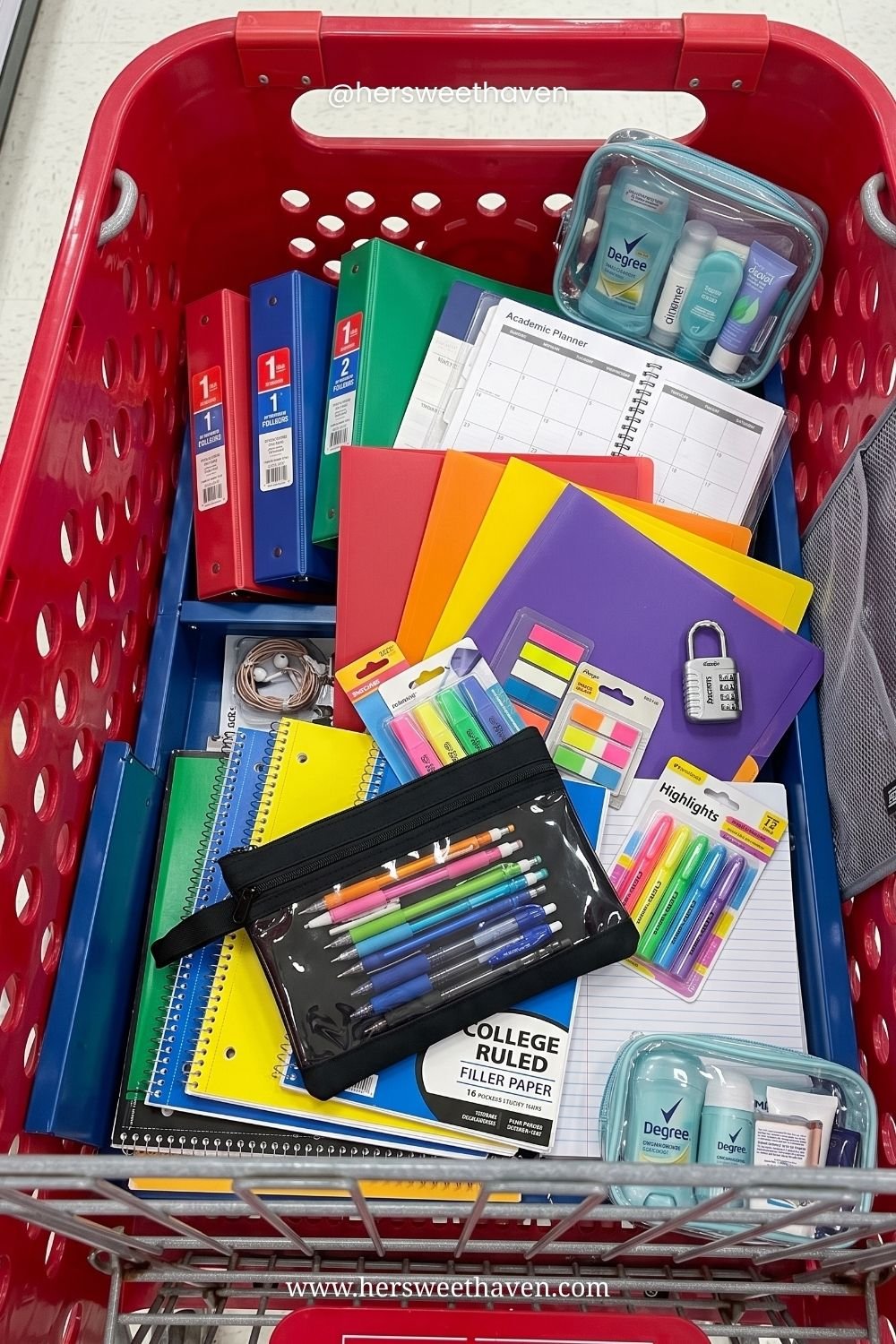
The list gets shorter and more organizational. One-inch binders, plastic folders with prongs, college-ruled filler paper, an academic planner, highlighters, sticky tabs, mechanical pencils and pens in a clear pouch, and a combination lock.
What parents forget: the small toiletry kit. Deodorant, hand sanitizer, a travel toothbrush, tissues, whatever else applies, in a zip pouch that lives in the locker. Middle school is when this becomes a thing and nobody wants to ask for it.
Also: buy the combination lock now and let them practice opening it at home for a week. A kid who can’t get their locker open in the two minutes between classes will just carry everything all day, and that’s how backpacks get destroyed.
Skip: the giant three-inch binder. It doesn’t fit in the locker, it doesn’t fit in the backpack, and by October they’ve abandoned it.
High School
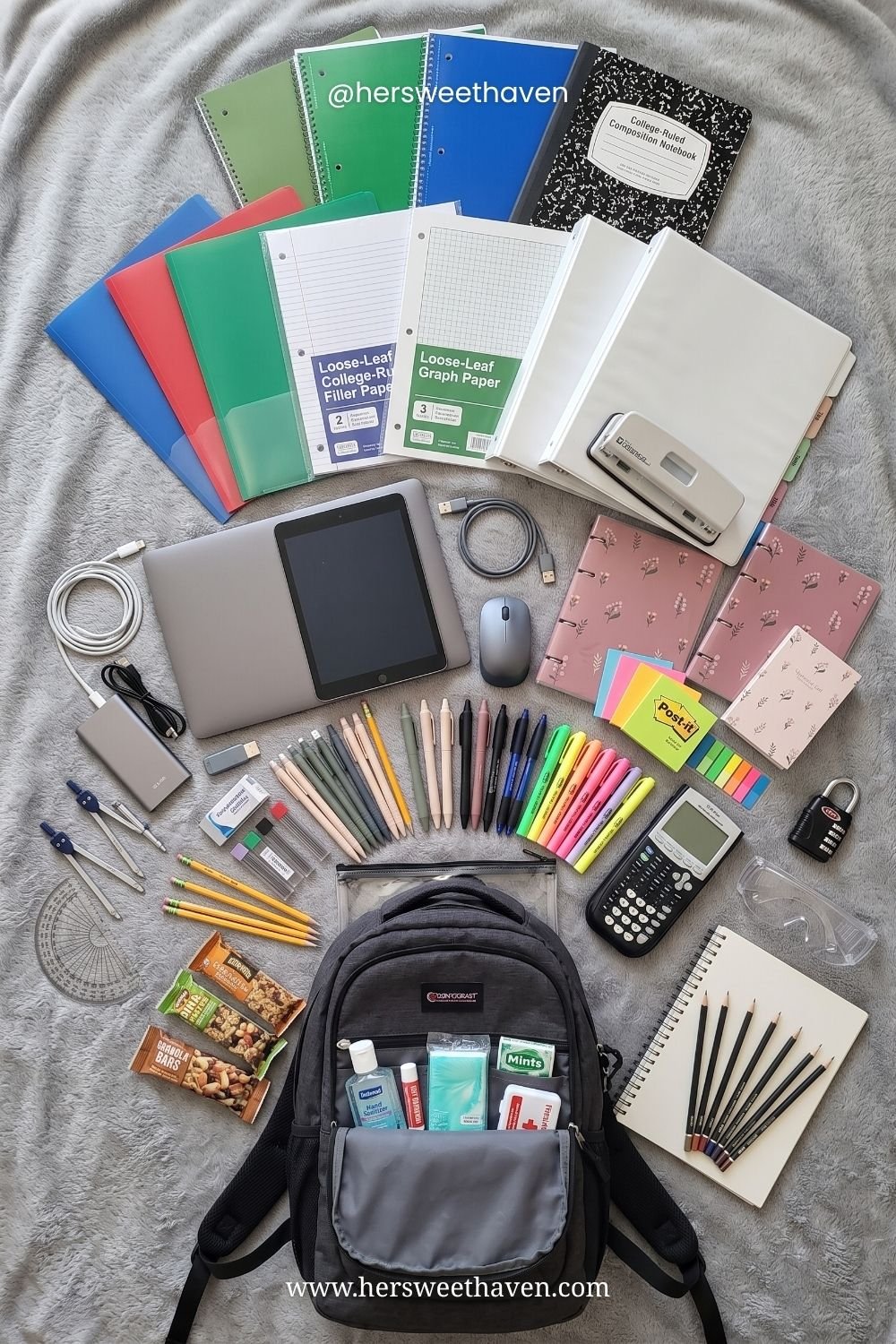
Fewer supplies, more equipment. Subject notebooks, a binder with dividers, graph paper for math and science, a hole punch, pens and highlighters, a graphing calculator (check which model the school requires before you buy, they are not interchangeable), a compass and protractor, safety goggles if there’s a lab, a sketchbook for art.
What parents forget: the charging setup. A power bank, a spare cable, and a small pouch for both. Half the school day runs on a laptop or tablet now and outlets in classrooms are scarce.
Skip: a new backpack every year if last year’s is fine. This is the age where the backpack becomes a status object and also the age where they stop caring by November.
Throw a couple of granola bars and a small first-aid pouch in the front pocket. Teenagers do not plan ahead about being hungry.
College
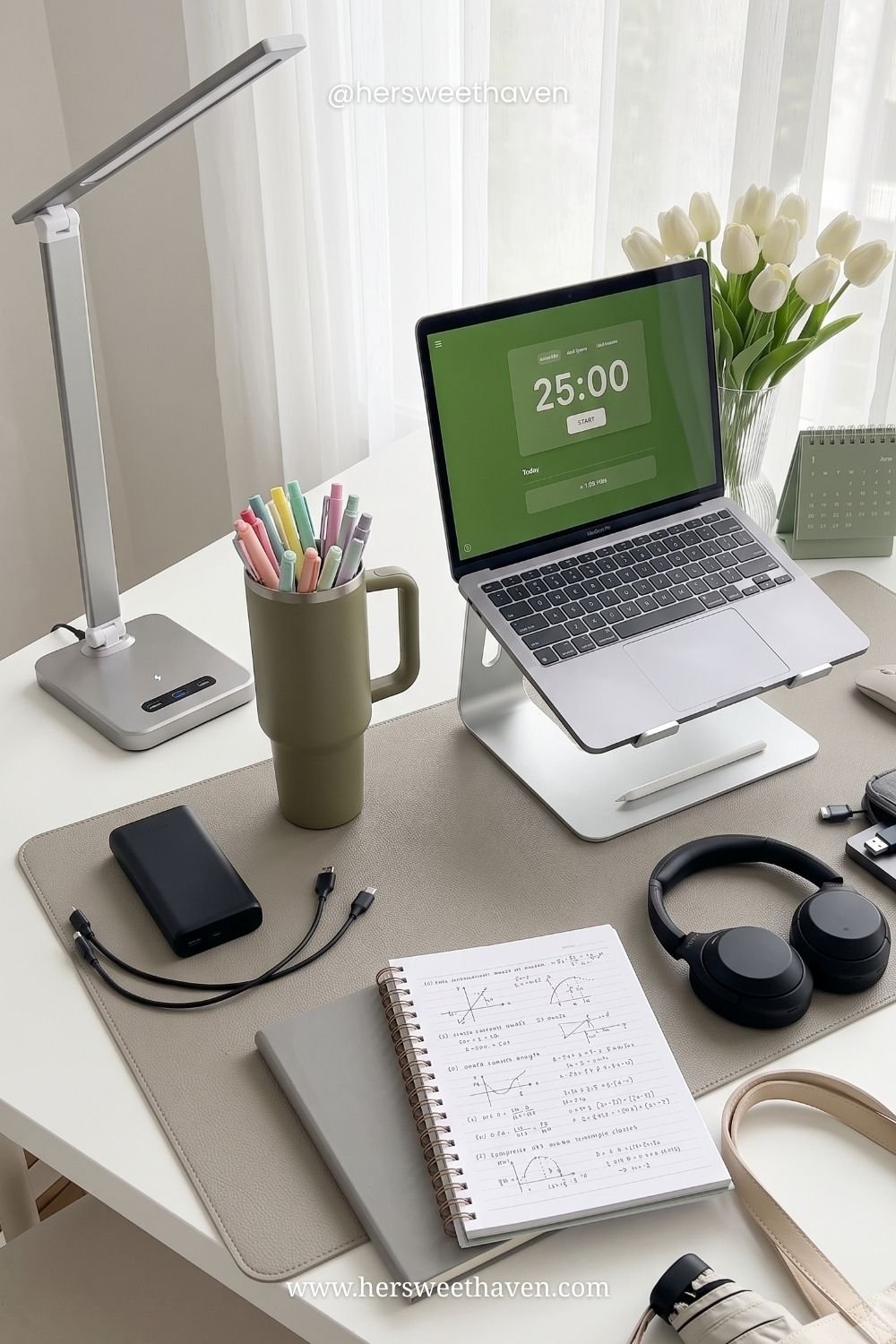
Almost nothing on the traditional list applies. What matters is the desk setup, because that’s where the work happens.
A laptop stand (posture, and it stops the fan from cooking), a real desk lamp, noise-cancelling headphones, a power bank, a multi-cable, a desk mat, and a big water bottle. Notebooks and pens, sure, but two of each rather than twelve.
What parents forget: the boring dorm stuff. A small toolkit, command strips, a mattress topper, a shower caddy, a laundry bag that isn’t a trash bag. None of it is exciting and all of it gets used daily. My dorm room decorating guide covers the rest of that setup, and the five-minute hairstyles and long-wear nails post handles the getting-ready half of the same morning.
Skip: a printer. Every campus has printing, it’s cheaper than ink, and a printer takes up a quarter of a dorm desk.
Lunches Kids Actually Eat
Ten boxes below, but the formula first, because it’s what makes any of them work.
The Formula and the Cold Rule
Build every box the same way: one or two proteins, one complex carb, one thing with real fat in it, and then fill the rest with fruit and vegetables. MOMables lays this out well if you want the longer version, and once you’ve done it three times you stop thinking about it.
Portions scale hard with age. A kindergartener eats roughly a cup of food total, an elementary kid closer to a cup and a half, and a teenager needs two cups plus roughly double the protein, which this age-by-age portion guide breaks down properly. Packing a kindergarten-sized lunch for a fourteen-year-old is why they come home starving.
Now the part that matters more than any recipe: keep it cold. Two ice sources, not one, and put one on top of the food and one underneath. An insulated bag holds temperature far better than a hard box. If lunch sits in a warm classroom from 7:30 until noon on a hot September day, one thin ice pack is not going to cut it.
Set up a lunch shelf in the fridge with the components already portioned and the whole thing takes four minutes in the morning instead of fifteen. A fridge you can actually see into is doing half the work here.
Buy the containers before you plan a single lunch, too. A box with fixed compartments forces the proportions for you, which sounds like a small thing and removes the entire daily decision of how much of what to pack. Two boxes per kid, so one can be in the dishwasher. (One box per kid is how you end up washing a lunch container at 10pm. Ask me how I know.)
The No-Cook Assembly Boxes
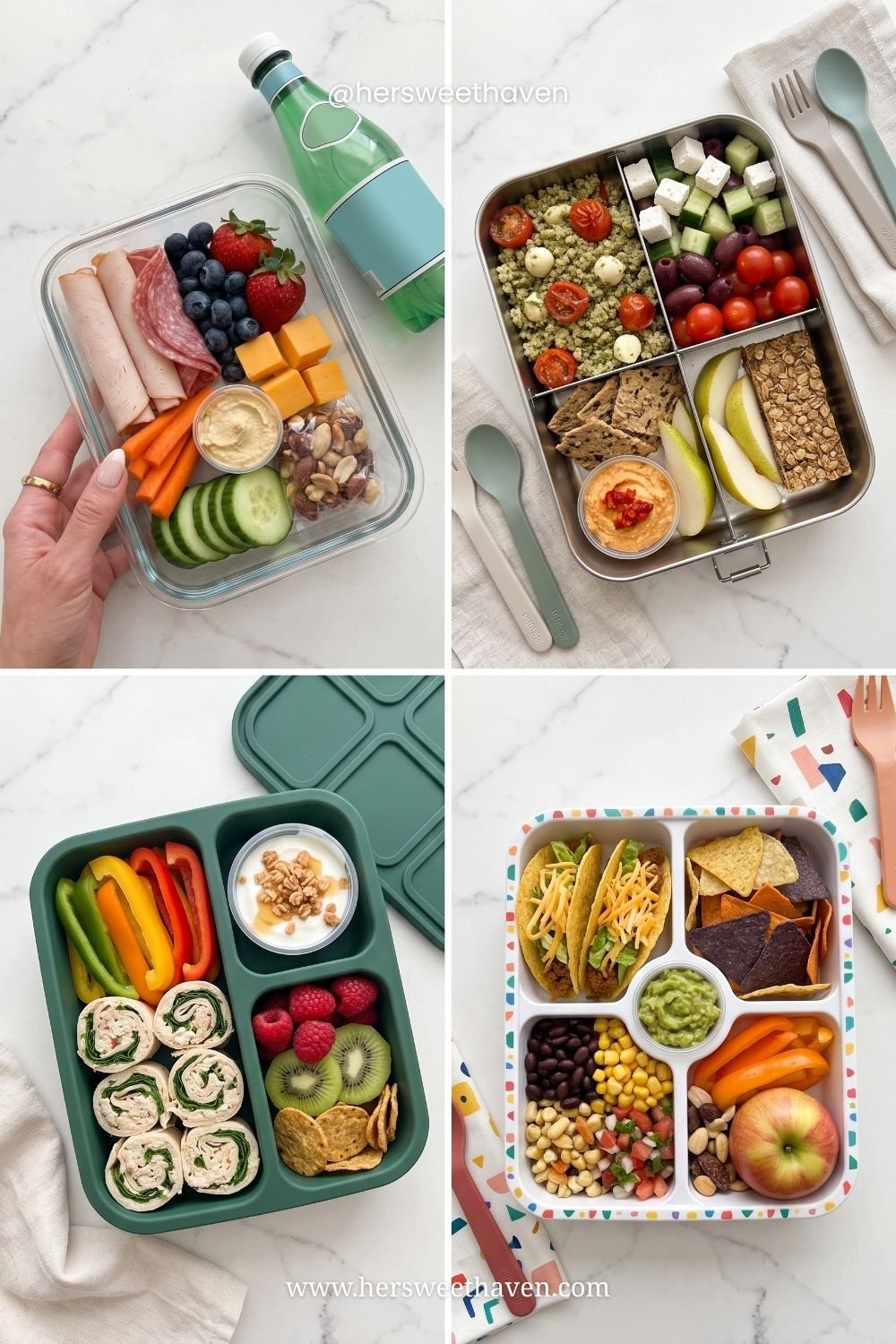
Four boxes, zero cooking. A charcuterie-style box with rolled turkey and salami, cheddar cubes, hummus, carrots, cucumber, berries, and nuts. A quinoa and pesto box with feta, olives, tomatoes, crackers, and pear.
Then a pepper-strips box with chicken pinwheels, yogurt and granola, and raspberries. And a build-your-own taco box with beans, corn, pico, guac, and chips.
The taco one is the sleeper hit. Kids assembling their own lunch eat more of it, every time.
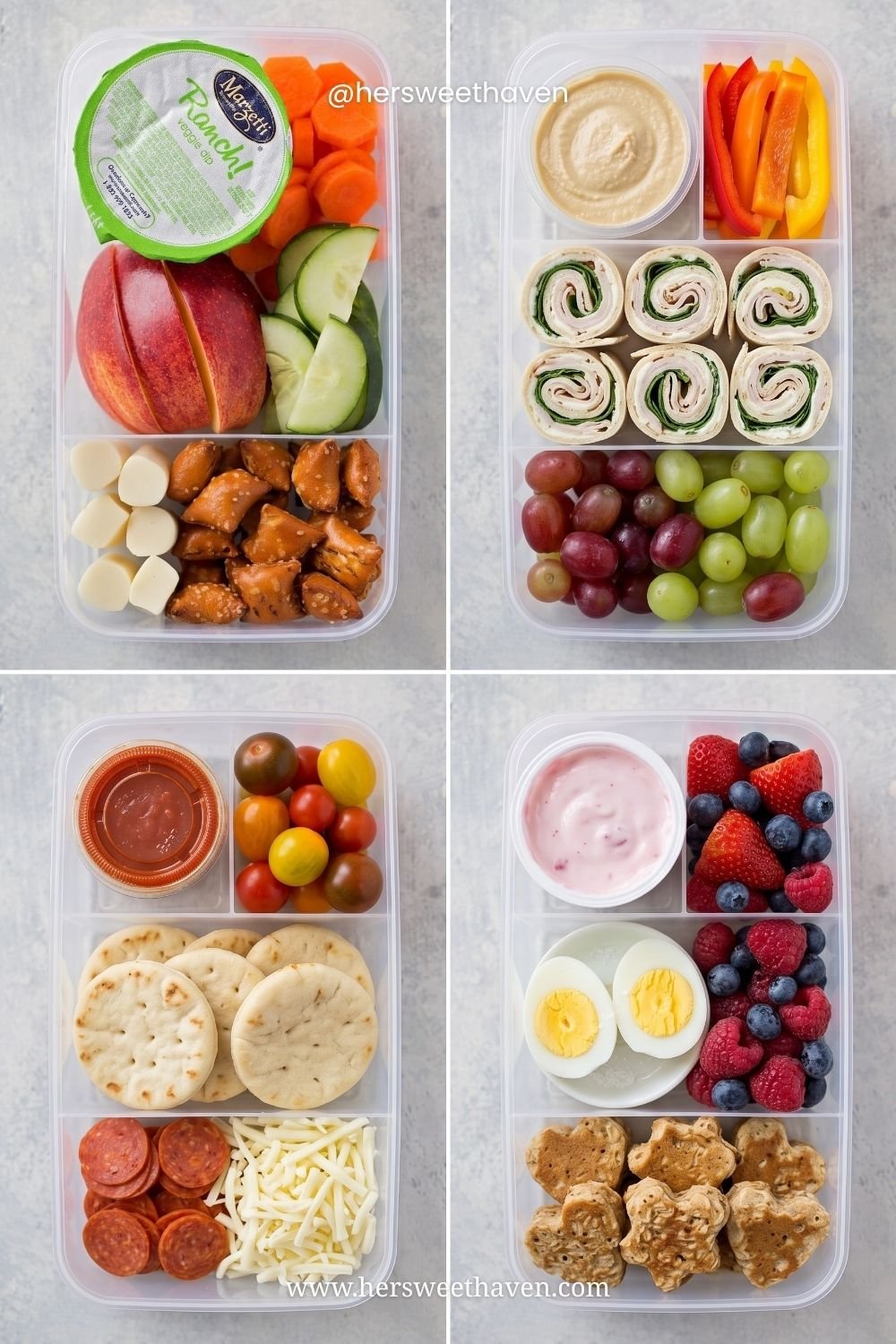
Same principle, simpler ingredients. Ranch and carrots with a whole nectarine, cucumber, cheese, and pretzel pieces. Hummus with pepper strips and turkey pinwheels.
A DIY pizza box: marinara cup, mini pitas, pepperoni, shredded mozzarella. And a breakfast-leaning one with yogurt, berries, a hard-boiled egg, and mini waffles.
The DIY pizza is the one to keep in rotation for a picky eater. It’s four ingredients and they get to build it.
The Sandwiches Worth Eating
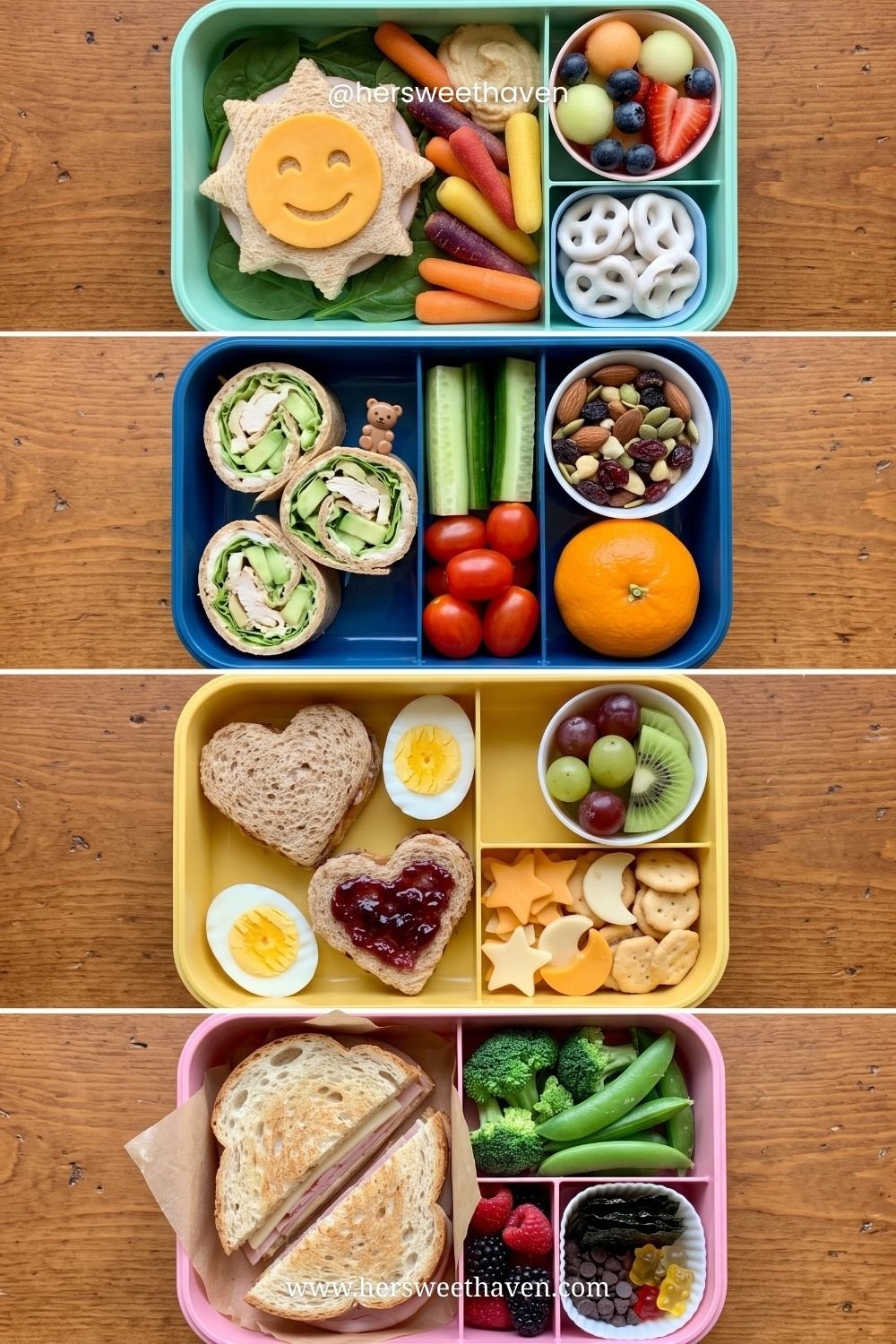
A sandwich isn’t the problem. A boring, squashed, plain sandwich is the problem.
Cut it into a shape with a cookie cutter and lay a cheese face on it. Roll it instead of stacking it. Make it a heart.
Use a cutter on the cheese too, since stars and moons take ten seconds and change how a six-year-old feels about the whole box. Then surround it with color: carrots, melon, berries, snap peas.
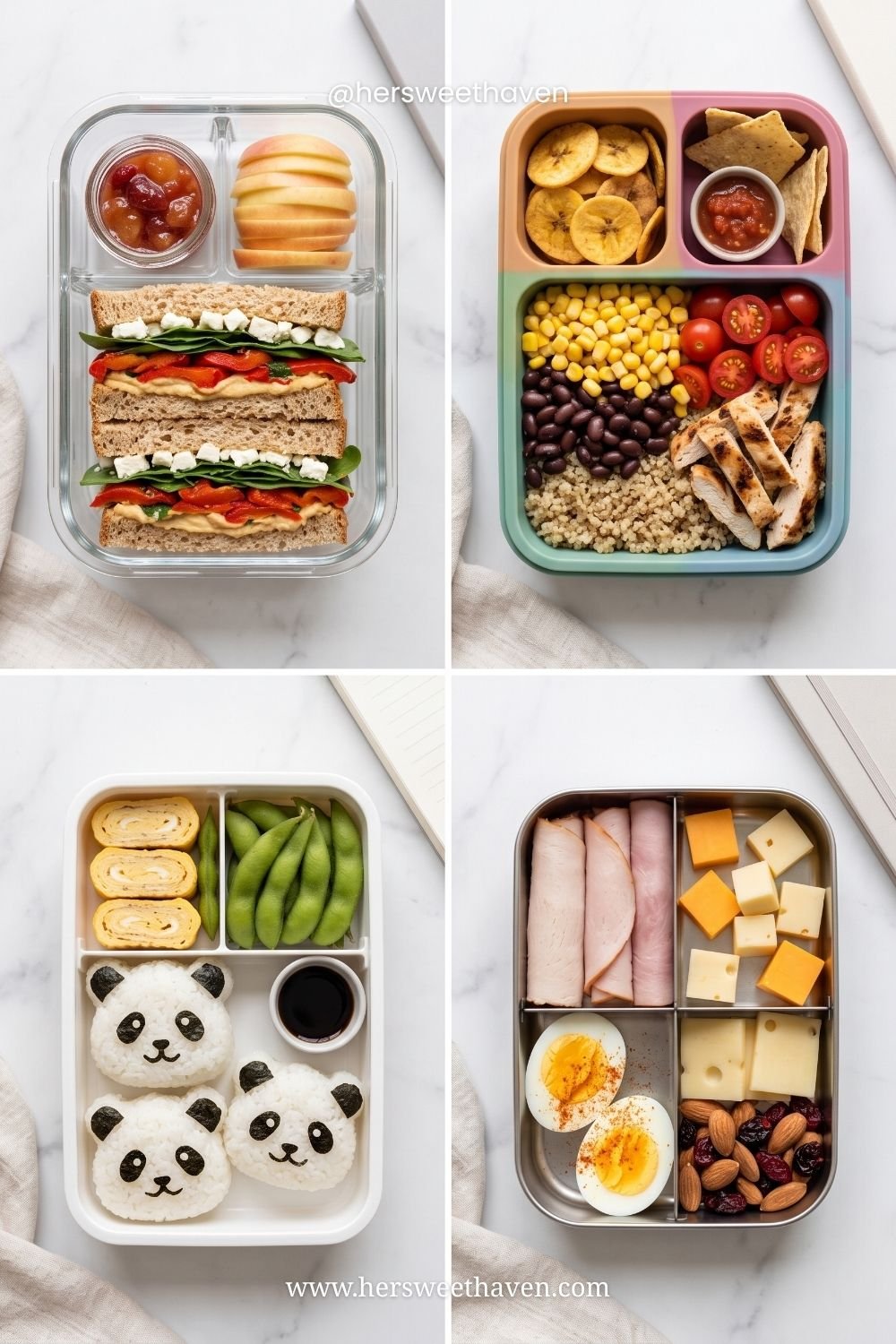
For older kids, upgrade the filling instead of the shape. Hummus with roasted red pepper, feta, and spinach. A burrito bowl with quinoa, black beans, corn, and grilled chicken.
Panda onigiri with tamagoyaki and edamame if they’re into it. Or a straight protein box: ham, cheese cubes, a paprika-dusted hard-boiled egg, almonds and dried cranberries.
That last one takes about ninety seconds and it’s the one my inbox asks about most.
The Pinwheels and Wraps
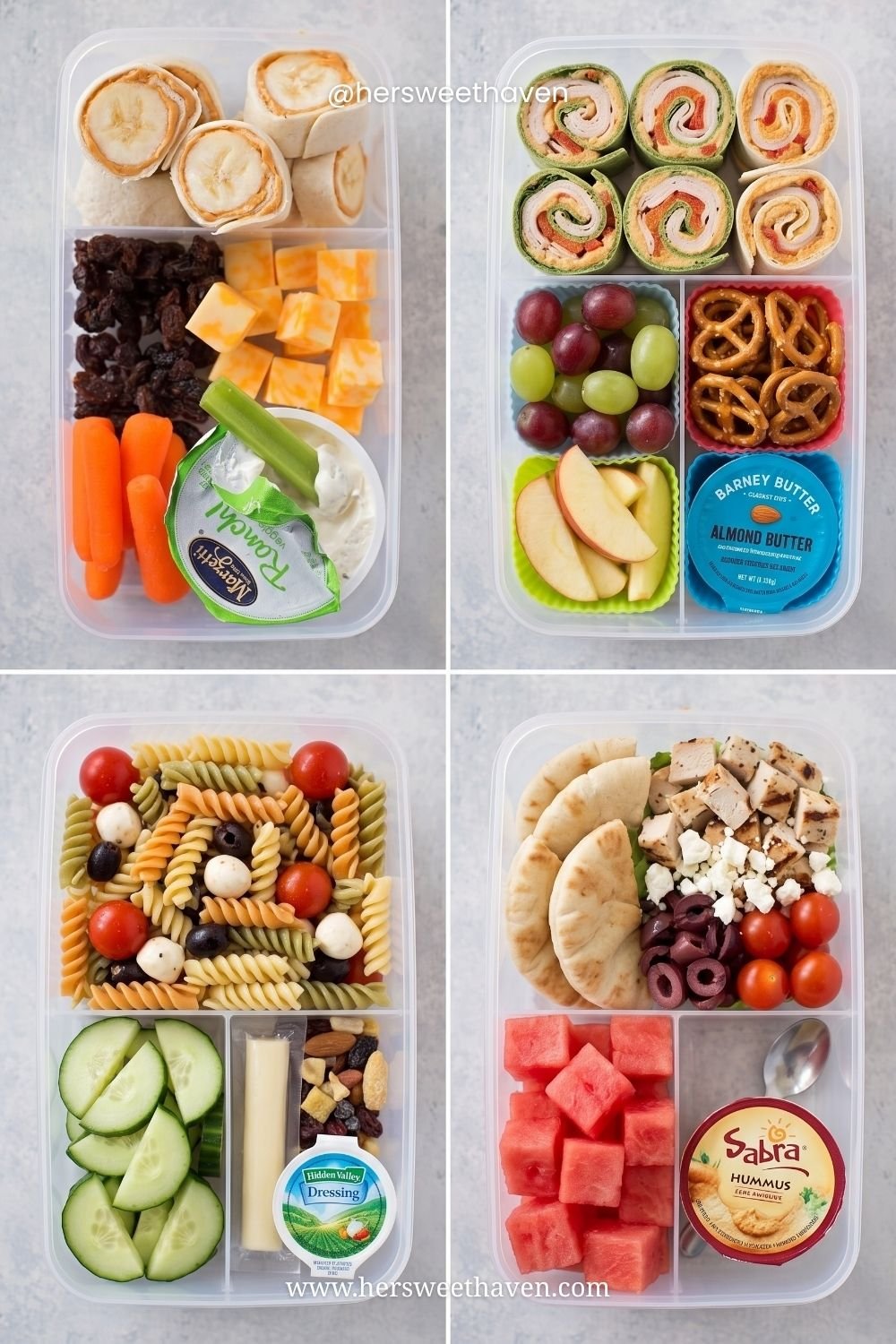
Pinwheels are the highest return per minute in this entire post. Spread, layer, roll tight, slice. They hold their shape, they don’t go soggy, and they look like effort.
Peanut butter and banana. Turkey and spinach. Turkey and cream cheese on a spinach tortilla for color. Add grapes, pretzels, apple slices with almond butter, and you’re done.
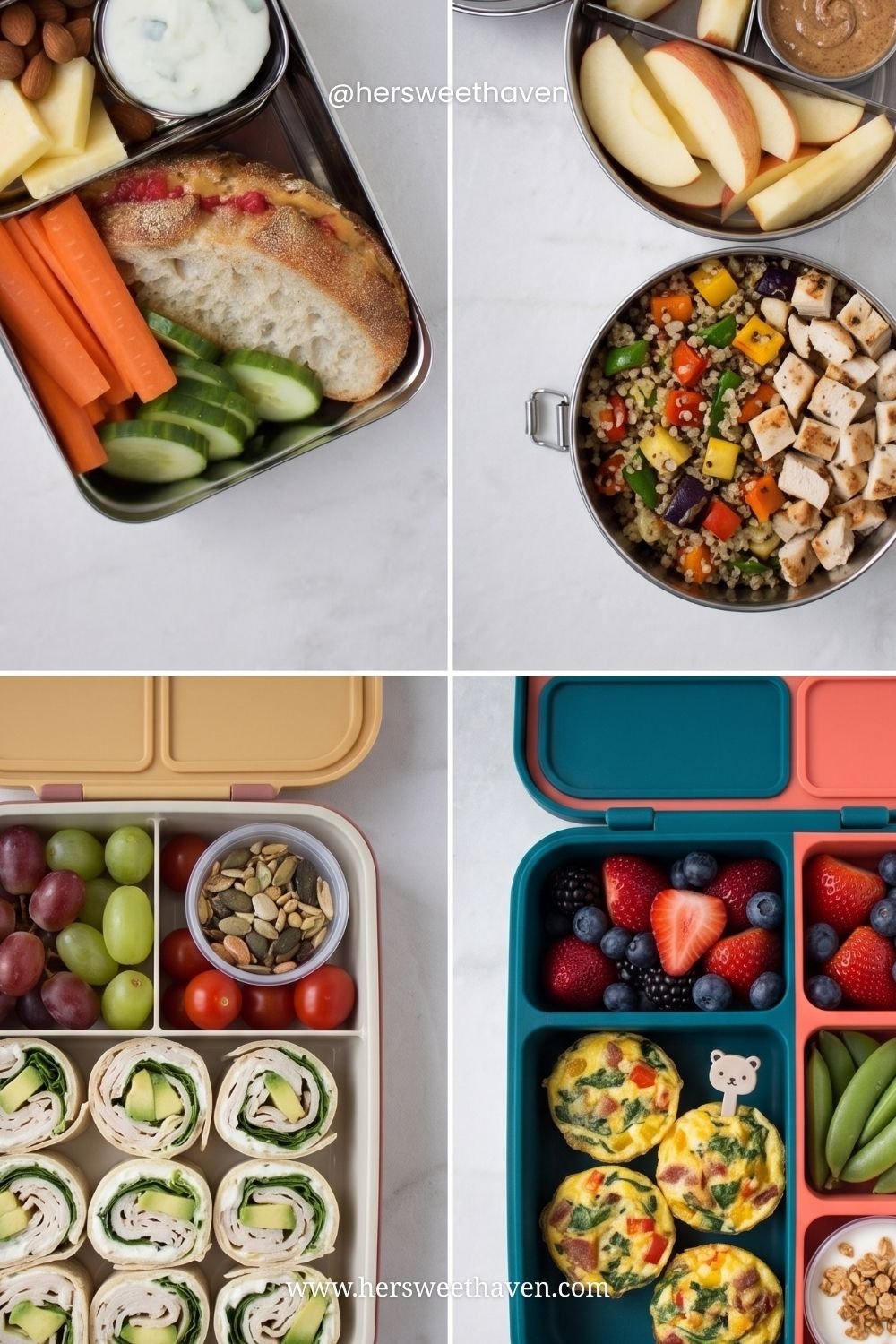
The trick with pinwheels: roll them the night before, wrap the whole log in plastic, and slice in the morning. A chilled log cuts into clean spirals. A room-temperature one squashes into ovals and unrolls in the box.
Turkey and avocado is the best-tasting version and the one that needs eating that day. Pair it with grapes, seeds, and tomatoes.
The Warm Ones
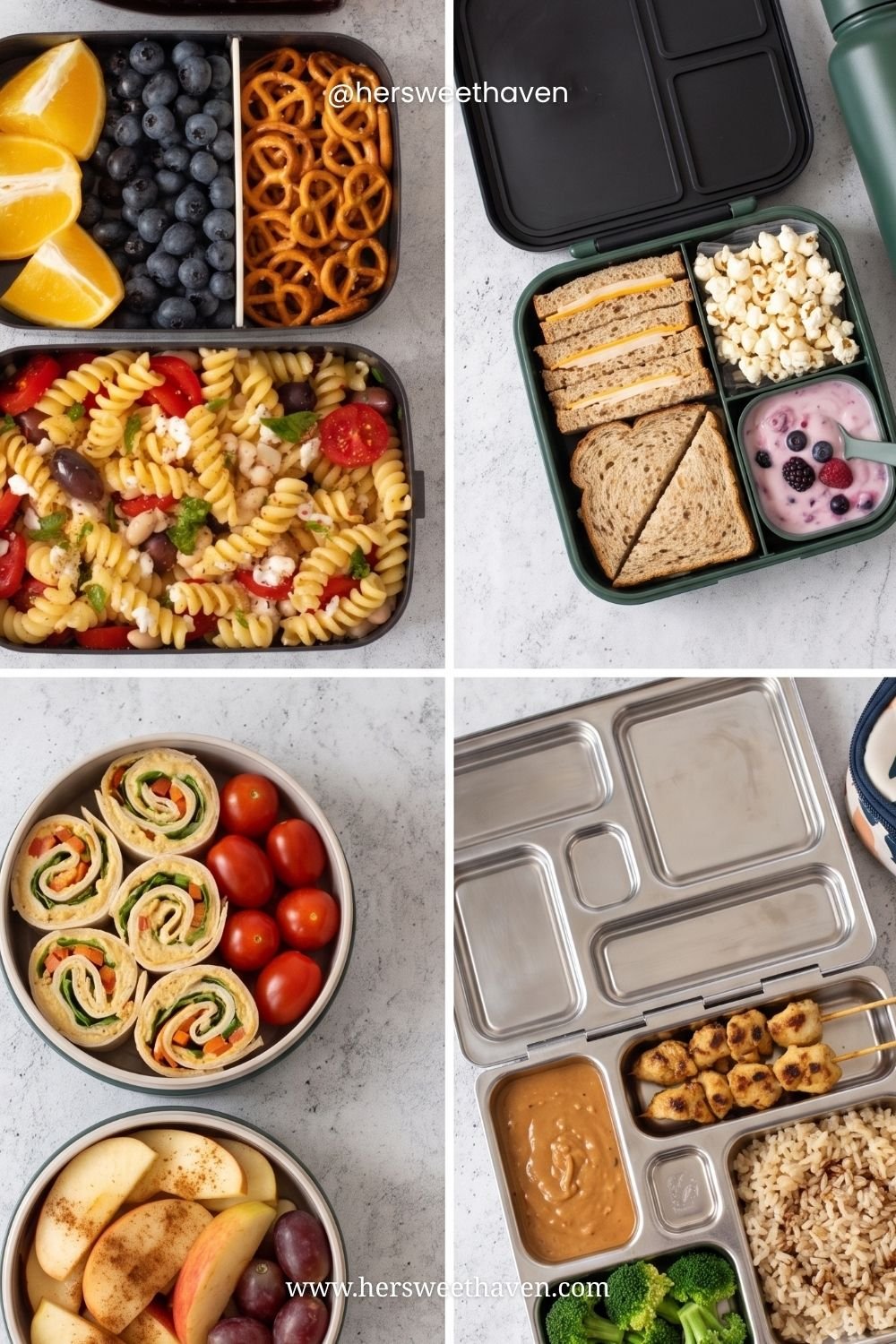
Cold-weather months need something warm, and a decent thermos changes the whole lunch. Rotini pasta salad with feta and olives works cold or warm. Chicken satay skewers with peanut sauce, rice, and broccoli goes in the thermos and comes back empty.
Preheat the thermos with boiling water for five minutes, dump it, then add hot food. Skip that step and it’s lukewarm by ten.
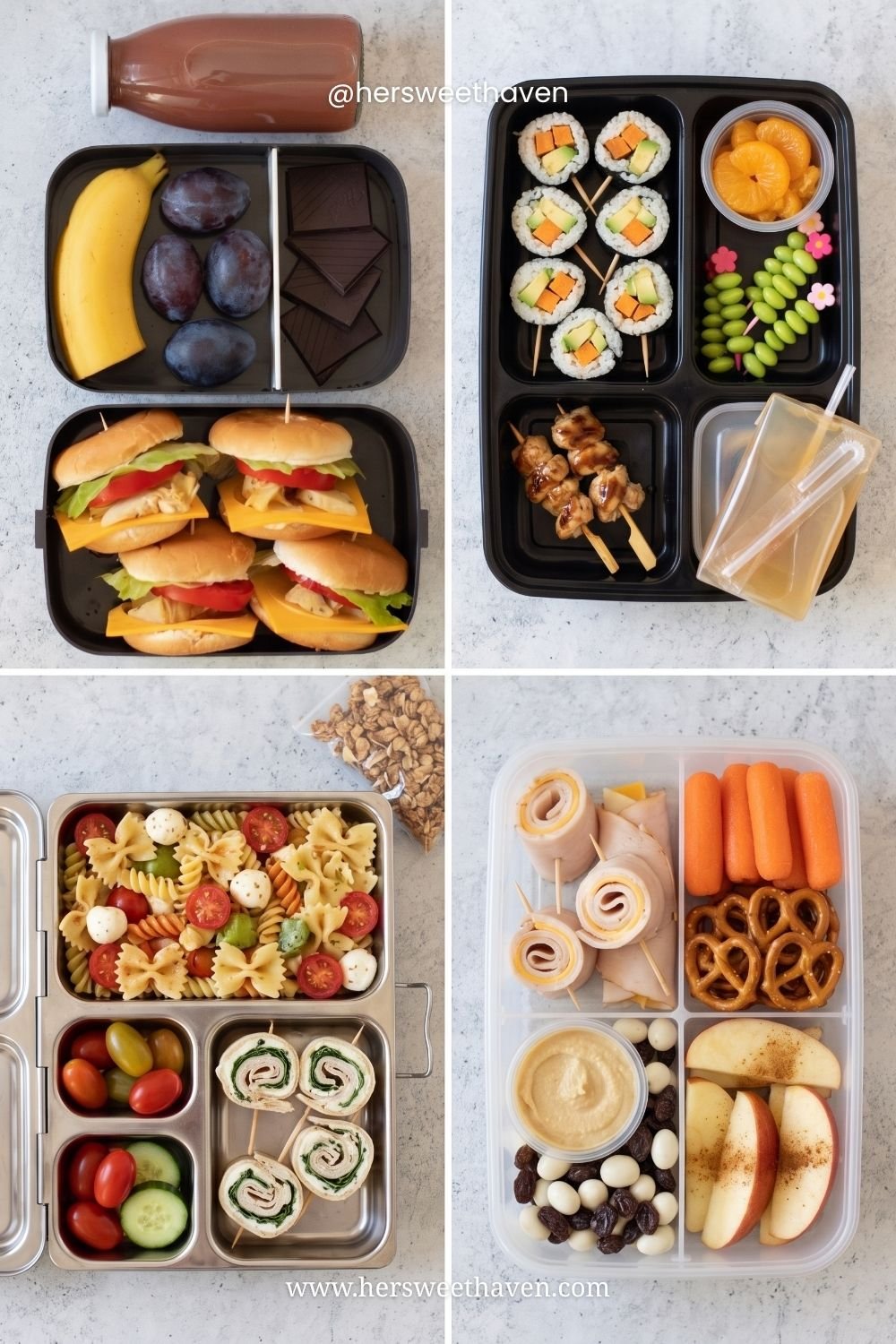
Or lean on last night’s dinner. Chicken sliders. Veggie sushi from the weekend. Pasta salad made Sunday that feeds three lunches.
The chocolate milk in that first box isn’t an accident either. One thing they’re excited about makes the rest of the box get eaten.
Breakfast-for-Lunch and Protein Boxes
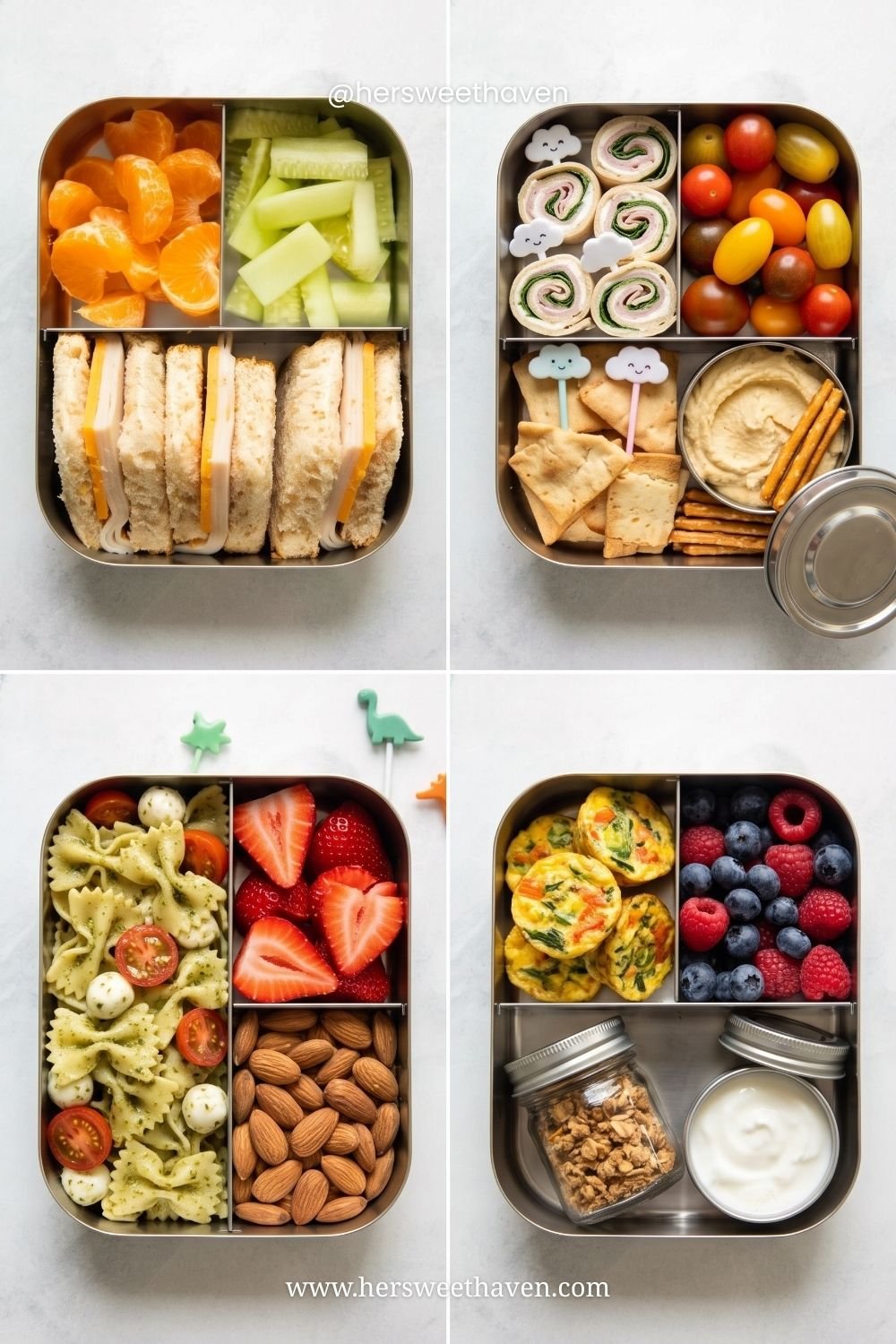
Mini egg muffins are the most useful thing you can batch on a Sunday. Bake a dozen, refrigerate, they go in lunches all week. Add berries and a small jar of granola with yogurt on the side.
Finger sandwiches with mandarin and cucumber for the little ones. Pesto farfalle with mozzarella for the pasta-only kid. Food picks (dinosaurs, clouds, bears) are two dollars and do a surprising amount of work at this age.
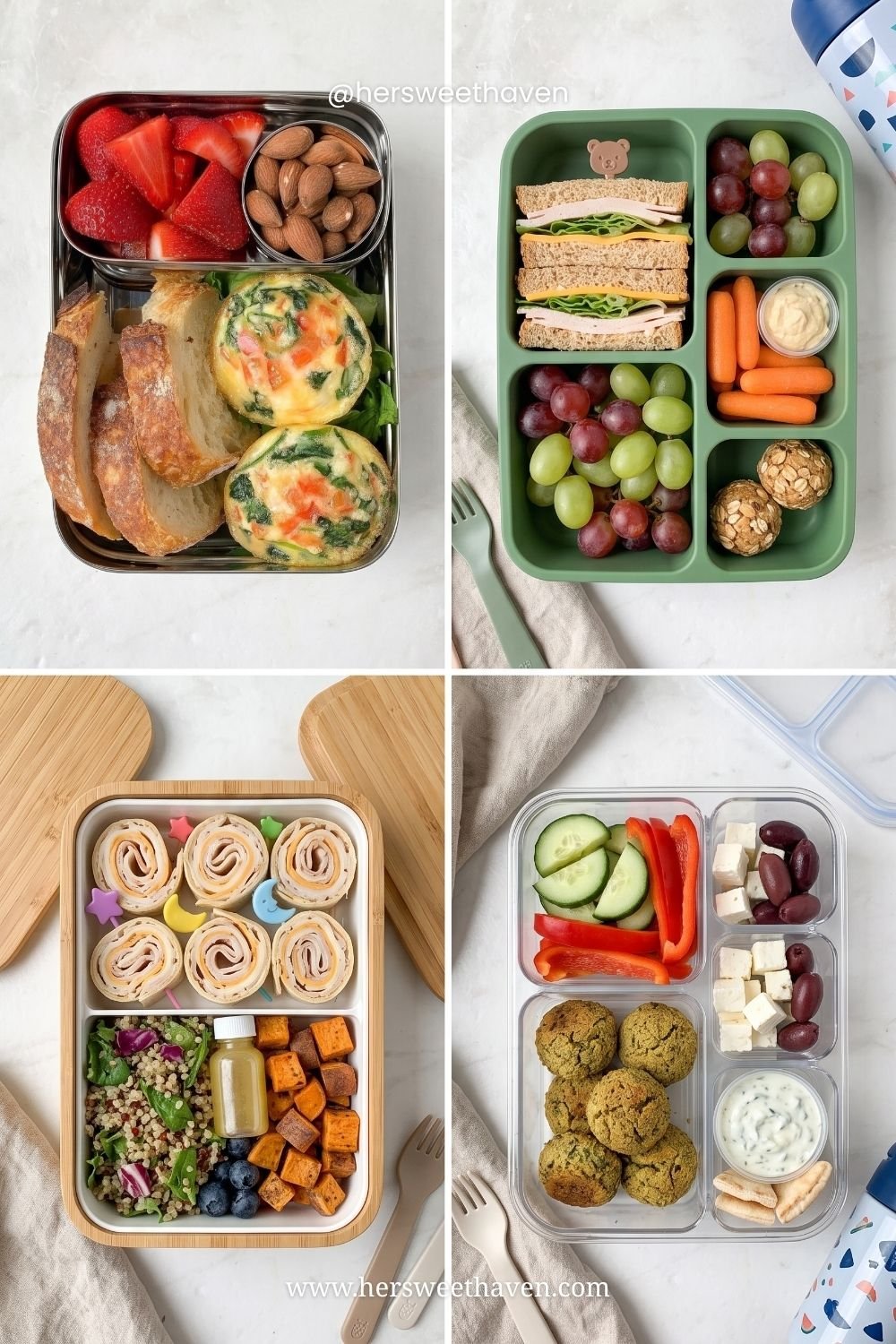
The grown-up-ish end of the range: egg muffins with sourdough and strawberries, oat energy balls next to a classic turkey sandwich, quinoa salad with roasted sweet potato and a little dressing bottle, falafel with cucumber, feta, olives, and tzatziki.
Pack the dressing separately. Always. A dressed salad at 7am is a wet salad at noon.
First-Day Photos You’ll Take in Four Minutes
You will not have twenty minutes. You’ll have the gap between shoes going on and the door opening. Plan for that.
Two rules that fix most first-day photos: shoot in open shade rather than direct morning sun, and get down to the kid’s eye level. A pro’s take on back-to-school photos makes the same point about shade, and it’s the difference between a nice photo and five photos of a squinting child. (I have an entire album from one year of everyone grimacing into the sun. Never again.)
The Two-Minute Setup
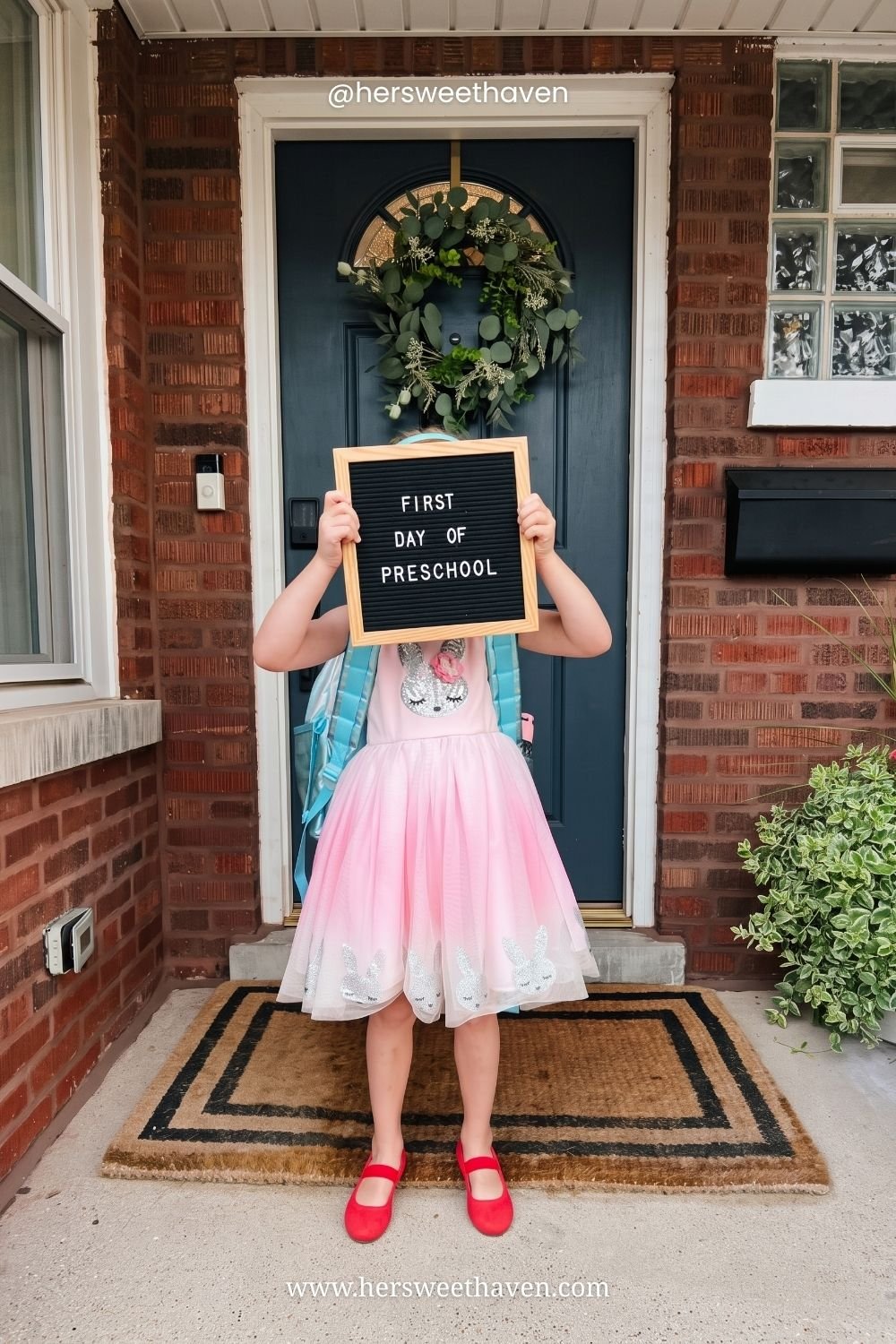
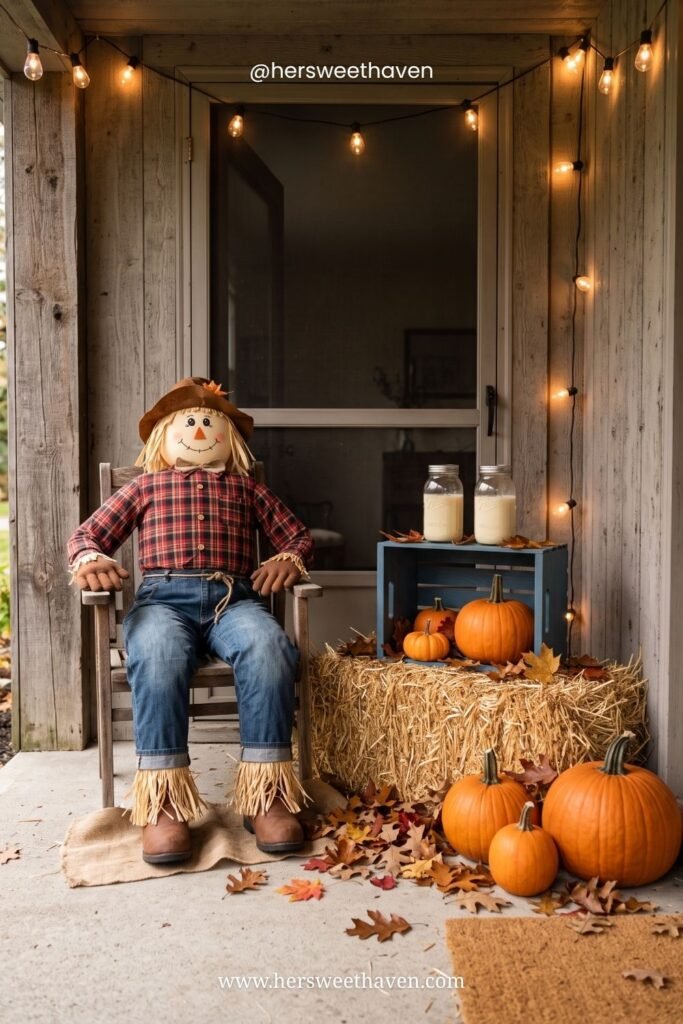
Front door, letterboard, done. Your porch is already the best backdrop you have: consistent every year, shaded most mornings, and it takes zero setup.
A felt letterboard costs about fifteen dollars and works for thirteen years of first days. Shoot it straight on, at their height, and take three frames instead of one.
The version where they hold the board over their face is worth taking too. Nobody has to be photogenic and it’s genuinely funnier in five years.
Signs, Boards, and Pennants
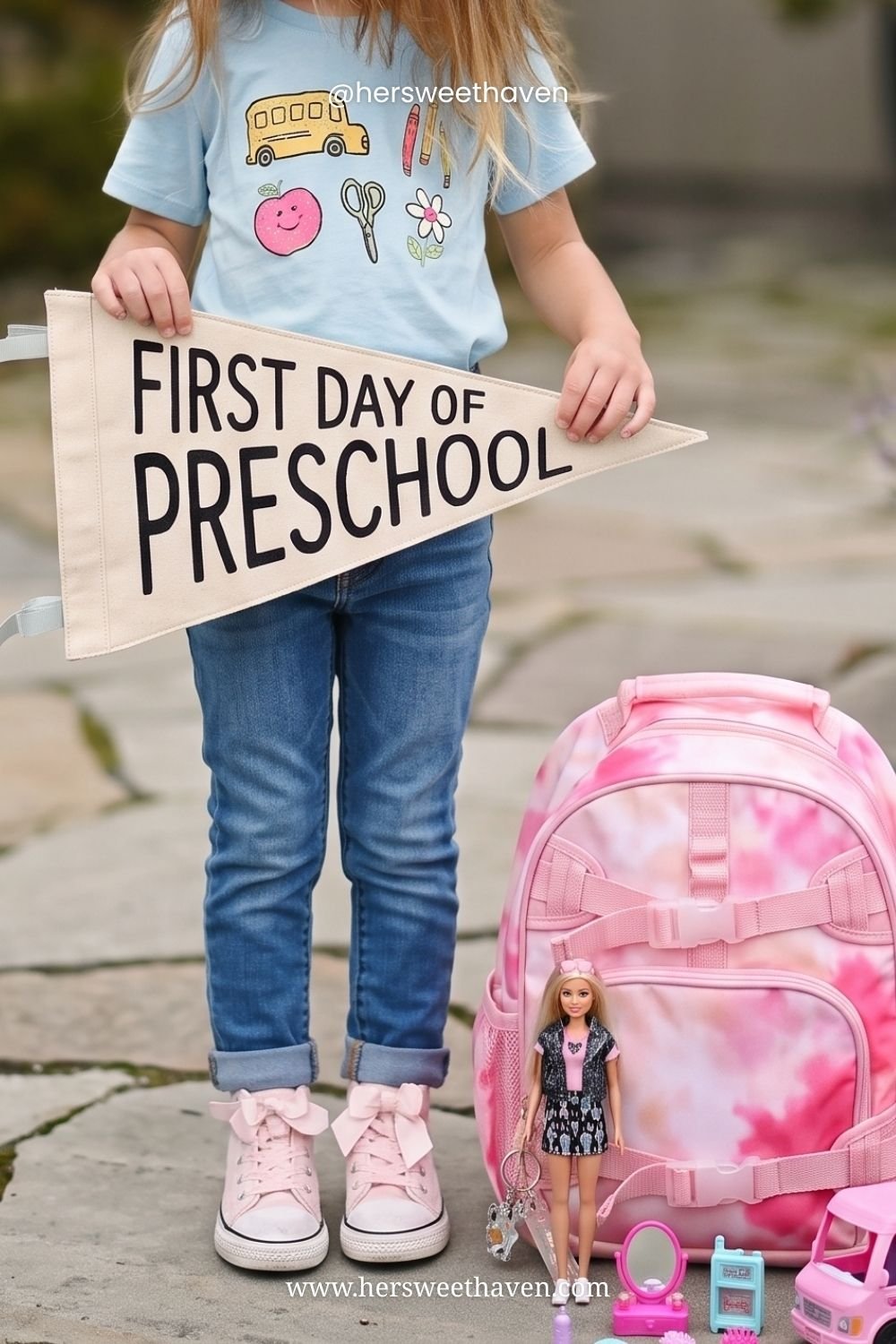
If the letterboard feels fussy, a canvas pennant is faster. No letters to arrange at 7am, which matters more than you’d think when someone can’t find a shoe.
Shoot it from slightly above with the backpack and one favorite toy in frame. The toy dates the photo better than any sign does. You will not remember which doll was the important one that year, and the photo will.
The Shot That Isn’t Posed
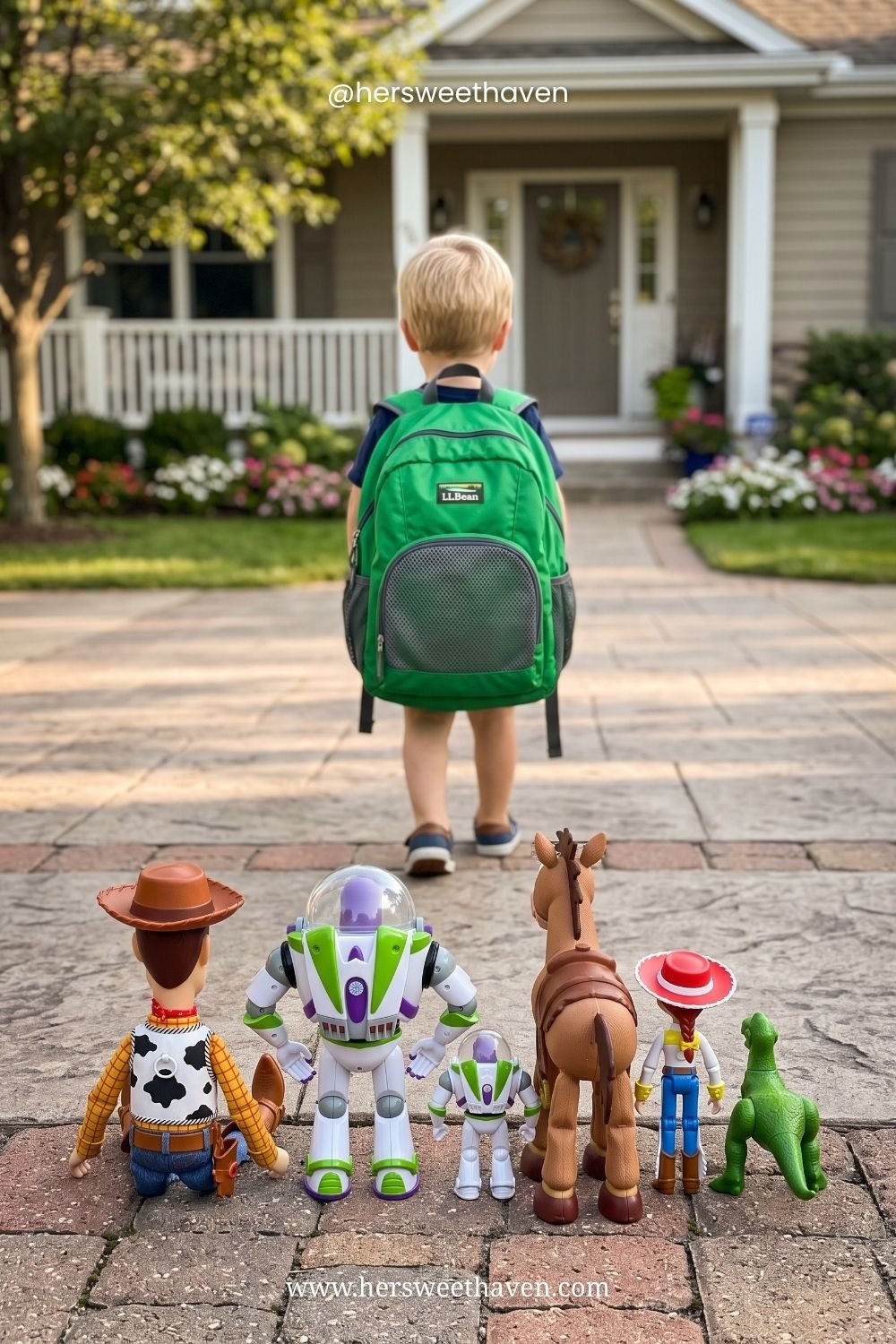
This is the one that ends up framed.
Shoot from behind as they walk away. Backpack on, house in the background, no face, no forced smile. It works because it’s the actual moment instead of a performance of it, and candid frames while they’re heading out the door consistently beat the posed ones.
Lining up their toys watching them go is a small addition that costs thirty seconds and wrecks parents completely. Consider yourself warned.
If You Want to Go Bigger
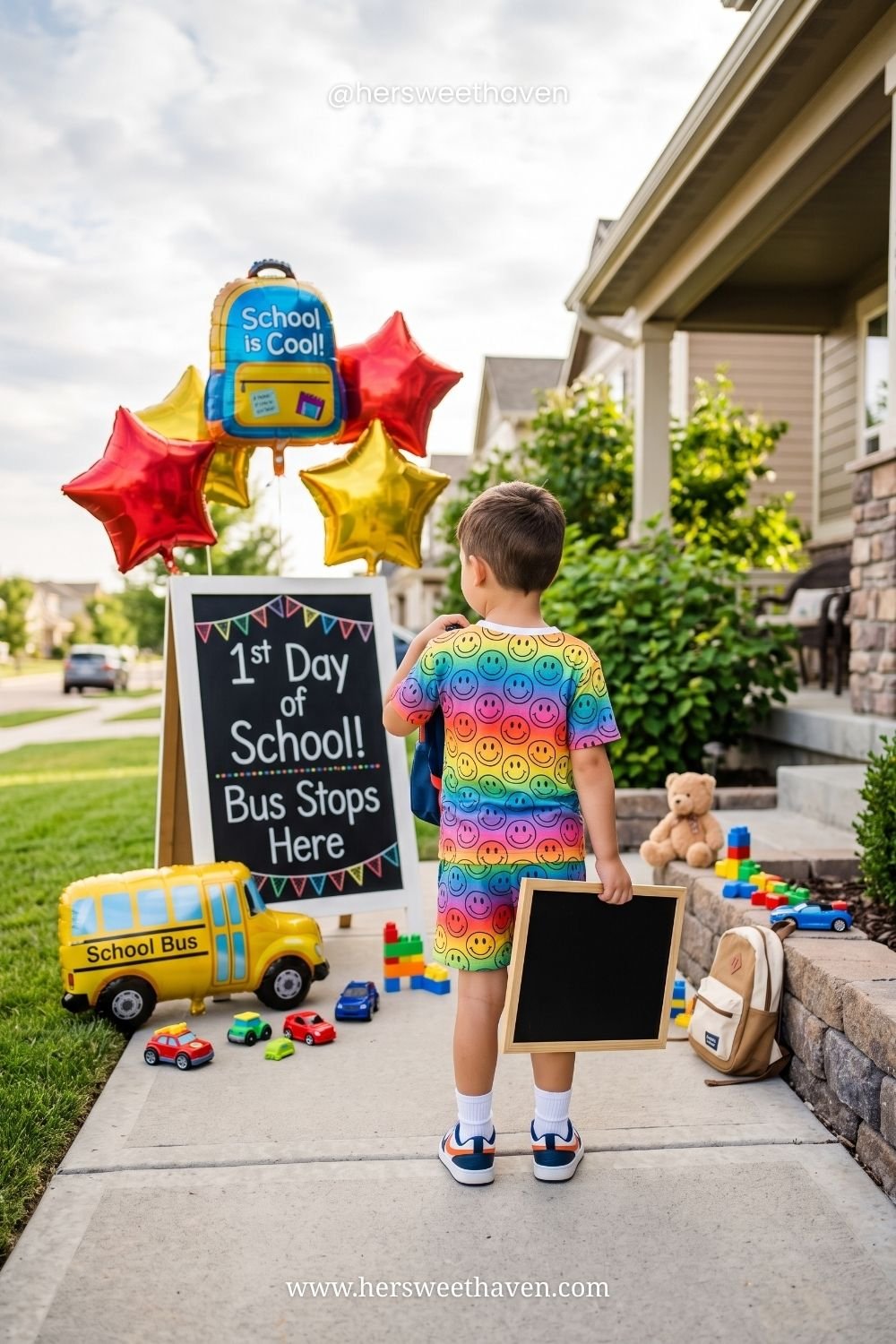
Some years you have the energy. A chalkboard A-frame, a few balloons, their toys scattered on the walk.
Set it up the night before. All of it. The balloons, the sign, the props, staged and waiting so the morning is just “stand there.” Trying to build a scene while a kid is dressed and the clock is running is how the whole thing falls apart.
Balloons are the highest-impact prop for the money and they photograph well in flat morning light.
The Vintage Desk Mini Session
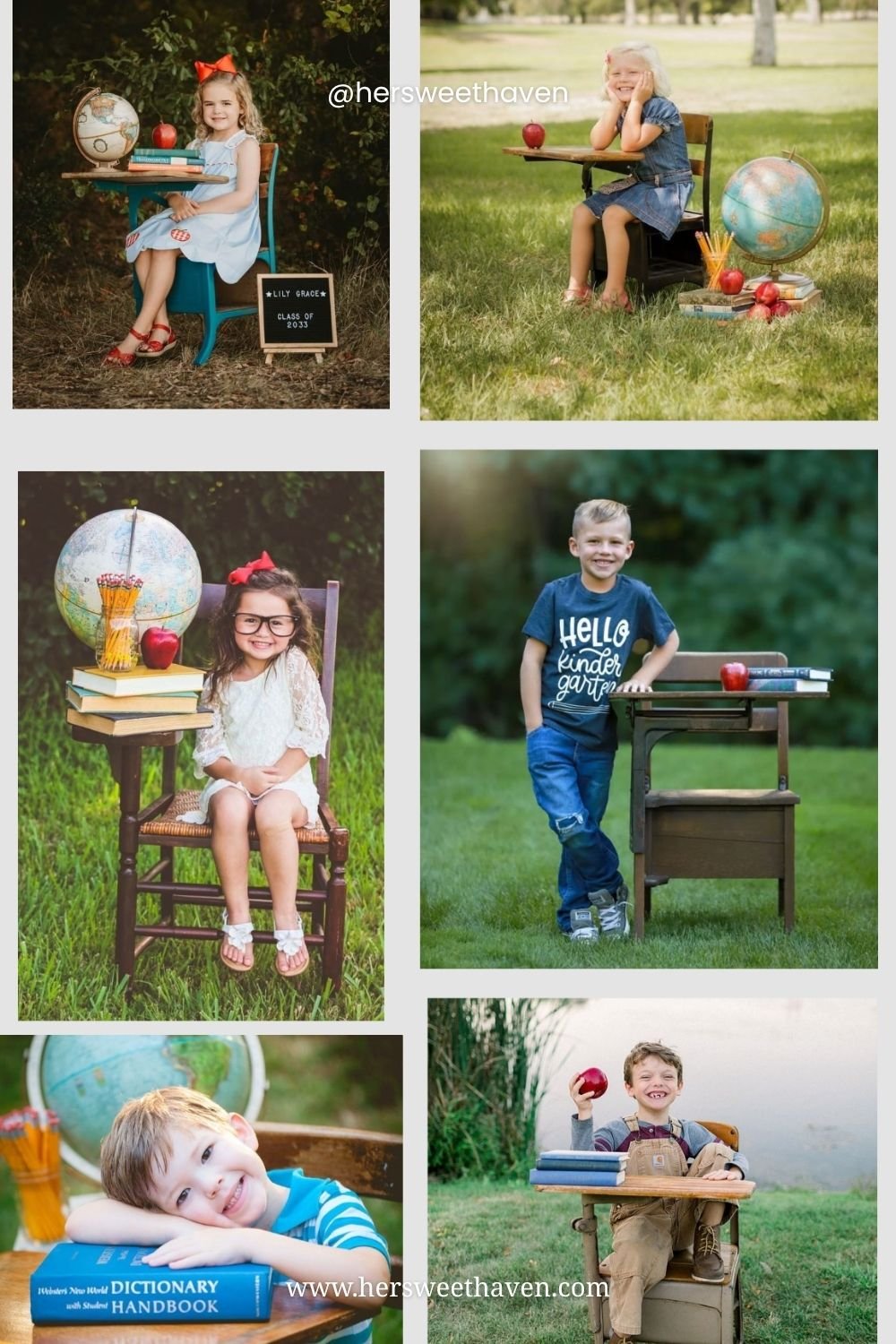
If you want something beyond a porch shot, this is the setup worth the effort. An old wooden school desk, a globe, a stack of books, an apple, a small letterboard with the graduating year.
Shoot in the evening rather than the morning, in open shade or with the sun behind them. Get low, at desk height. And instead of asking for a smile, ask for a twirl or tell a bad joke, because “say cheese” produces the exact face you don’t want.
Do it the weekend before, not on the day. First-day nerves show up in the eyes and you’ll have zero time anyway.
Whatever you shoot, decide now where it lives, or you’ll have thirteen years of first-day photos scattered across a camera roll. My guide to photo books, memory boxes, and junk journals covers the low-effort versions. And if you’re coordinating what they’re wearing in it, the back-to-school outfits worth screenshotting are already sorted.
The Four-Week Countdown
Spread it out and none of it is stressful. Cram it into the last weekend and all of it is.
Four weeks out. Get the teacher’s list. Do the closet inventory: what still fits, what’s destroyed, what’s missing. Order anything that ships slowly, especially a required calculator or specific headphones.
Two weeks out. Shop the supply list. Buy the lunch containers, ice packs, and thermos now while the selection is good. Order the letterboard or pennant if you’re doing one.
The weekend before. Label everything. Practice the locker combination. Batch the first week of lunch components: egg muffins, pinwheel logs, pasta salad, portioned snacks. Set up the homework station.
The night before. Lay out clothes. Pack the backpack. Stage the photo props if you’re going bigger than the front door. Pack as much of the lunch as will keep.
The night before should be boring. That’s the entire goal.
Your Back-to-School Prep Questions
How Much Should You Actually Spend?
For elementary, the teacher’s list itself usually lands between forty and sixty dollars if you buy store brands and shop the early-August sales. Middle and high school run lower on supplies and higher on equipment.
Where it’s worth spending: headphones, the lunch bag and containers, the backpack, and a graphing calculator you’ll use for four years. Where it isn’t: branded folders, novelty pencil cases, the premium version of anything communal.
The real money leak isn’t any single item. It’s the second trip in September for things you already own but couldn’t find.
How Do You Keep a Packed Lunch Cold Until Noon?
Two cold sources, one above the food and one below, in an insulated soft bag rather than a hard box. A frozen water bottle counts and doubles as the drink.
Freeze what you can. Yogurt tubes, applesauce pouches, and juice boxes all work as ice packs and thaw by lunch. And chill the box itself in the fridge overnight so you’re not starting from room temperature.
What If Your Kid Refuses Everything You Pack?
Ask them to pick two things per box. Not the whole lunch, just two. Involvement changes the refusal rate more than any recipe does.
Then pack smaller. An overfull box reads as a chore to a small kid, and a half-eaten large lunch looks like failure while a finished small one looks like a win. Same amount of food, completely different feeling at pickup.
If something comes back untouched twice, stop making it. You are not going to win that one, and there are nine other boxes on this page.
When Should You Buy Supplies?
Early August for the main list, which is when the sales are running and the shelves are still full. The specific-color folders and the required calculator models go first and they do not restock in a useful timeframe.
Wait on clothes, though. Buy the first two weeks and hold the rest until October, because you’ll know by then what they actually wear and what they’ve grown out of.
Get the List Done This Week
The window that matters is right now. Supply sales are running, shelves are still stocked, and the specific things that sell out (the folders in the exact colors, the required calculator, the good insulated lunch bags) are still sitting there.
Two weeks from now you’ll be picking through a picked-over aisle, paying full price for whatever’s left, and making a second trip for the thing you couldn’t find.
So do the closet inventory tonight. Buy the list this weekend. Batch a tray of egg muffins on Sunday and put the letterboard somewhere you’ll find it at 7am. Then the first morning is just shoes, a photo on the porch, and out the door.
That’s the whole point of doing it early. The day itself gets to be easy.



Leave a Reply