

One evening. That’s genuinely all it takes to put together a gift that looks like you planned it since August. Not a weekend, not a spreadsheet, not a single one of those “start your holiday shopping in July!” articles that make the rest of us feel like garbage.
I’m saying this as a lifelong December shopper. Every year I promise myself I’ll be organized, and every year I’m standing in a store on the 18th wondering what my mother-in-law actually likes. What saved me wasn’t better planning. It was a better method.
Here’s the whole trick: stop hunting for one perfect item and build a small, themed collection instead. A basket of five or six well-chosen things reads as “she really thought about me” in a way that one panic-bought sweater never will. It’s the fastest route to thoughtful Christmas gift ideas when the calendar has already betrayed you.
Below I’ll compare the two approaches, break down exactly what goes in a basket for the girl in your life, for him, for parents, and for couples, and walk you through assembling one in an evening. Nobody has to know when you shopped.
One Gift vs. One Great Basket
Let’s settle this properly, because it’s the decision behind every December panic.
The single-gift approach is what most of us default to: find The Perfect Item, nail it, done. And when it works, it really works. The problem is that it demands one of two things you don’t have in December: deep knowledge of exactly what someone wants, or time to keep looking until you find it.
When it misses, it misses loudly. A generic candle, a random sweater, a gift card in an envelope. The recipient smiles politely, and you both know. (We’ve all given that gift. We’ve all received it.)
The basket approach flips the math entirely. Instead of one item carrying all the pressure, you pick five or six affordable things that fit a theme, and the theme does the heavy lifting. Every item is a small signal: I know you like this. I noticed you were out of that. That combination is what reads as thoughtful.
And here’s the practical part: five $12 items are easier to find fast than one perfect $60 item. You can build a genuinely good basket from a single shopping trip, which is exactly why it beats the solo gift in December. The verdict is not close.
The Basket Method, Recipient by Recipient
So what actually goes in one? Here’s how it looks for four different people, with real examples you can copy.
For the Girl Who Loves Her Routine
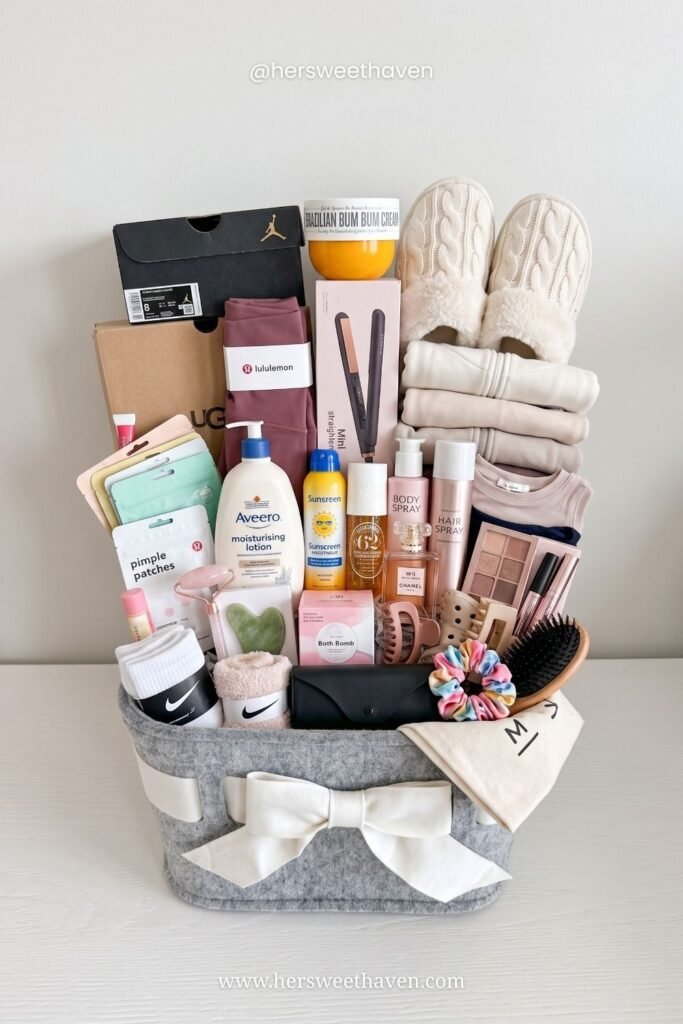
This is the getting-ready basket, and it’s the easiest one to nail. Cozy cable-knit slippers, a soft sweatshirt set, leggings, a mini hair straightener, body spray and lotion, sheet masks and pimple patches, a gua sha, scrunchies, a claw clip, and a small palette. Everything she reaches for on a slow Sunday or a rushed Tuesday.
The reason it works so well: these are all things she’d buy for herself but rarely does. Consumables and small upgrades feel indulgent without being risky. You’re not guessing her size or her taste in art, you’re just handing her the good version of her own routine.
Notice the color story too. Everything sits in soft pinks, creams, and neutrals, which makes a pile of random products look like it was styled on purpose. That’s a two-minute decision that does a lot of work.
One caution with beauty items: skip anything that needs a shade match unless you know her exact products. Skincare, hair tools, and body care are safe for everyone. Foundation and lipstick are a gamble even for people who know each other well, so leave those out and spend the money on the cozy pieces instead.
For the Cozy Homebody (or the Student)
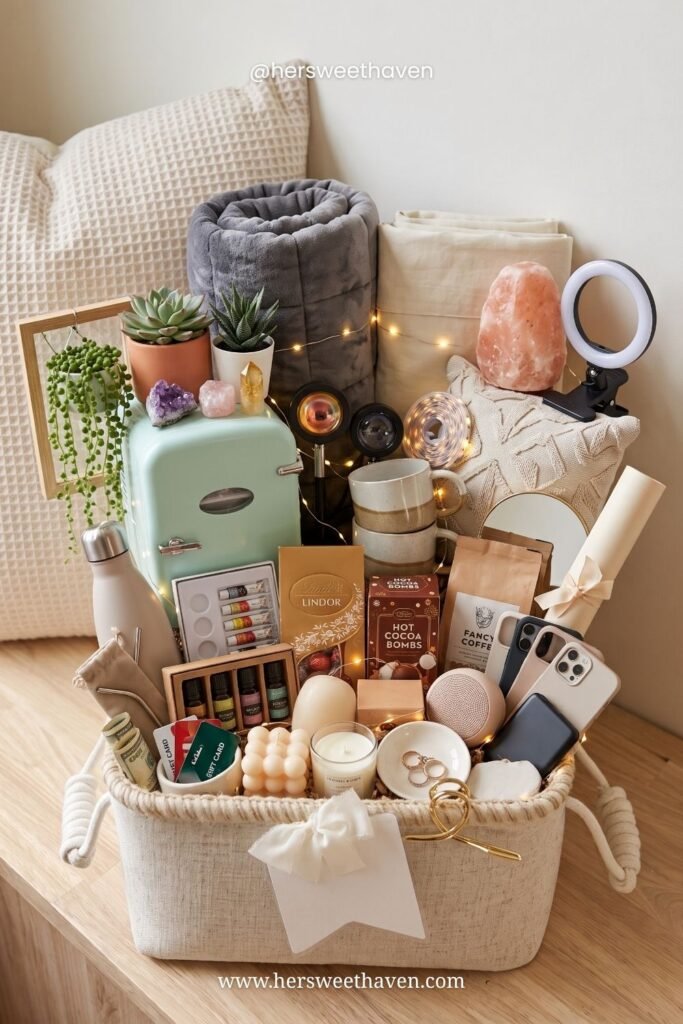
This one is my favorite for someone in a small space: a dorm room, a first apartment, a bedroom that’s also an office. A weighted blanket, a knit throw pillow, fairy lights, a salt lamp, a mini fridge, stacking mugs, hot cocoa bombs, fancy coffee, a small speaker, crystals and succulents, a candle, and a jewelry dish.
The theme here is “make your space feel like yours,” which is a genuinely lovely thing to give someone. It’s also the same restraint-plus-warmth idea behind my cozy-not-cluttered Christmas decor approach: a few nice textures and some warm light beat a pile of stuff every time.
Fair warning, a basket like this can climb in price fast if you add the mini fridge. Swap it for a nice mug and a bag of good coffee and nobody will notice the gap. (Your wallet will notice.)
For Him
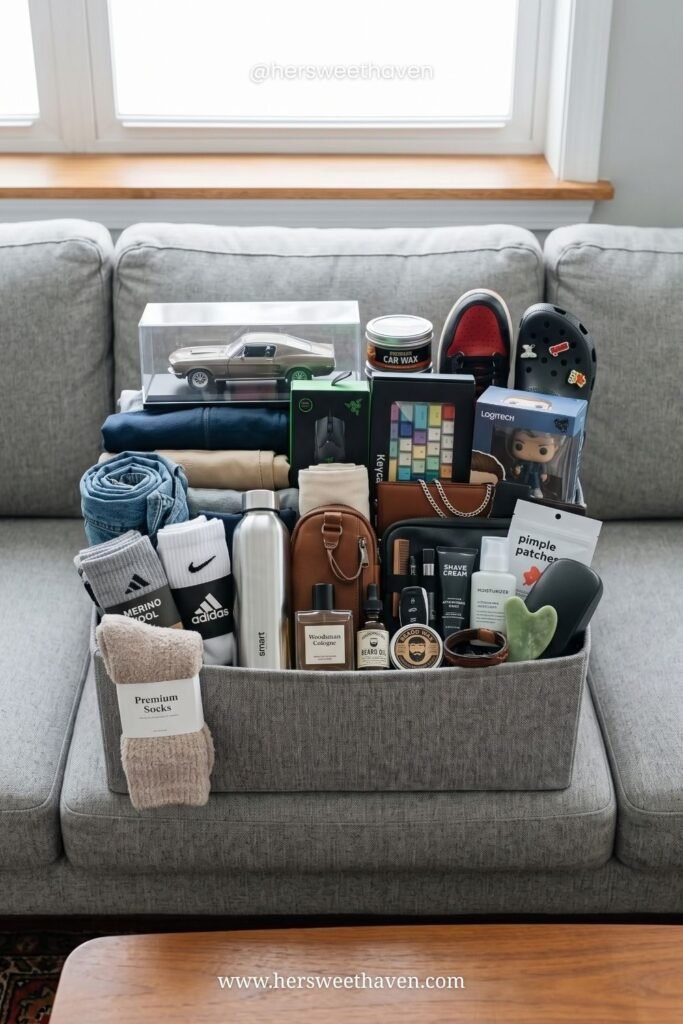
Men are famously hard to shop for, which I think is mostly a myth: they’re just harder to shop for with one item. Build a basket instead. Merino and athletic socks, a water bottle, cologne, beard oil and wax, shave cream, a grooming kit, a leather sling bag, a wallet, a keyboard or mouse for the desk setup, and one fun collectible.
The winning formula for him is upgrade-what-he-uses-daily. He already owns socks, but not nice merino ones. He has a wallet, but it’s falling apart. He’d never buy himself the good cologne. Every item says “I noticed” without requiring you to decode a hobby you don’t share.
Add one item that’s purely personal (the model car, the little figurine, something from a show he loves) and the whole basket stops looking generic. That’s the piece he’ll mention to people later.
Teen boys work the same way, by the way, just swap the cologne and grooming set for gaming accessories, snacks, and a hoodie. Same formula, different contents: daily upgrades plus one thing that’s specifically about him.
For Parents
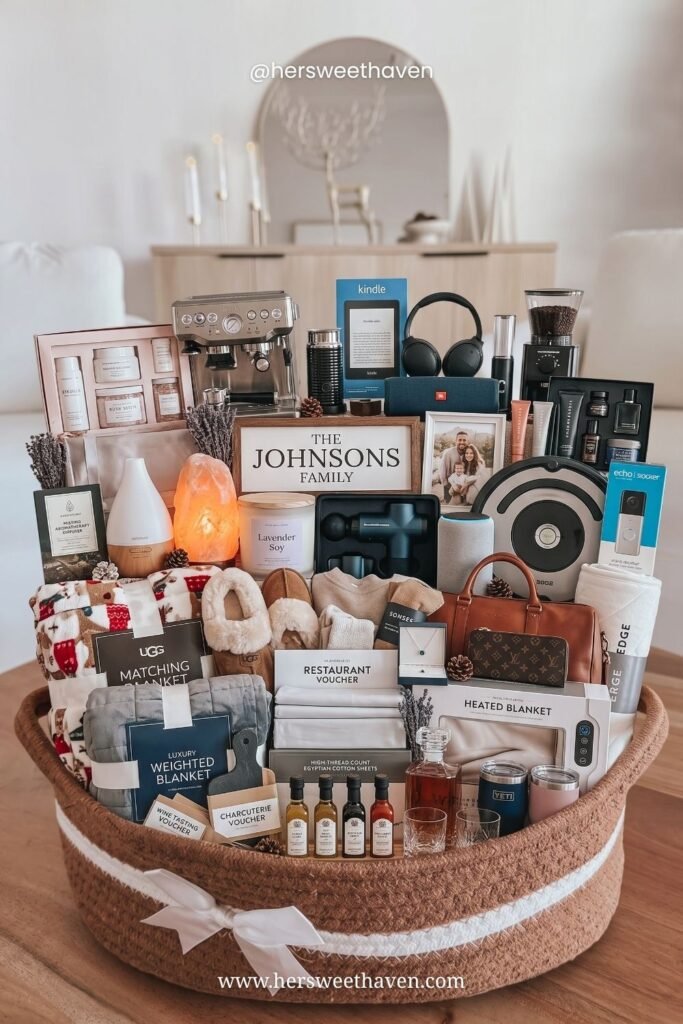
The parent basket is where I go for comfort plus one sentimental anchor. Look at this one: a family name sign, a framed photo, an espresso machine, a Kindle, headphones, matching blankets, slippers, a diffuser, a candle, a massage gun, cozy sheets, a restaurant voucher, and a wine tasting voucher.
The framed photo and the family sign are what turn a nice pile of gifts into something they’ll get emotional about. Those two items cost the least and mean the most, which is basically the entire lesson of gift-giving. Everything else is comfort, and parents rarely buy themselves comfort.
If your budget is tighter, scale it way down: a framed photo, a candle, cozy socks, their favorite tea, and a handwritten note. Same emotional hit, tiny fraction of the cost. Nobody counts the items.
The Couples Basket (The Hardest One to Nail)
Couples are the trickiest category, because you’re shopping for two people with different tastes and probably a shared home full of stuff already. Here’s how I solve it.
Lead With Experiences
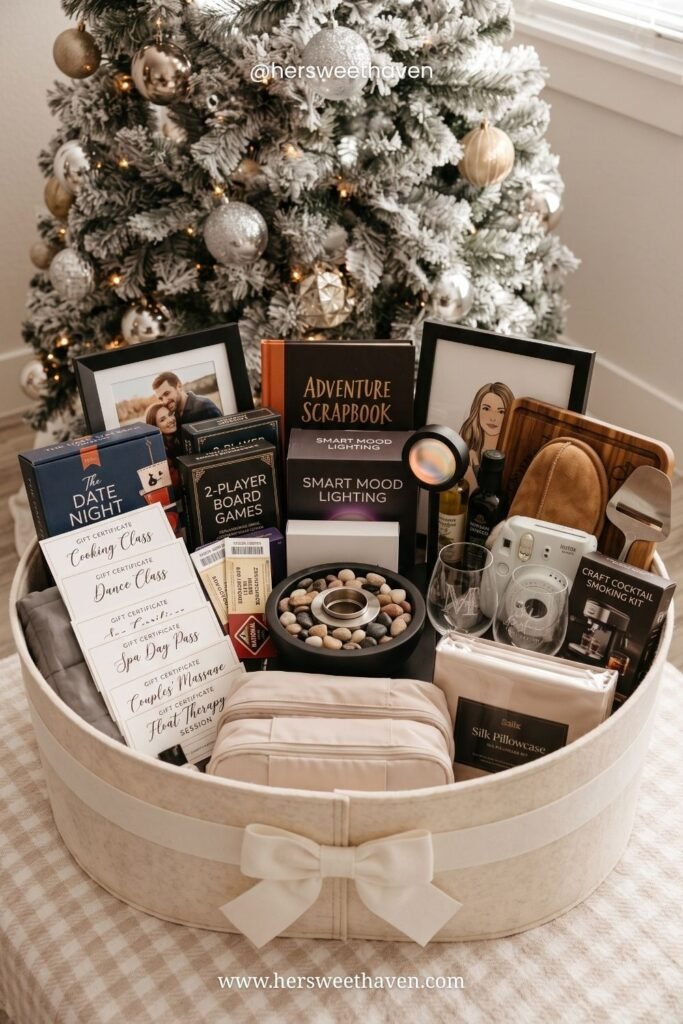
The move is to gift time together, not more objects. This basket does it beautifully: gift certificates for a cooking class, a dance class, a spa day, a couples massage, plus a date night box, two-player board games, and concert tickets. Then a few physical anchors: an adventure scrapbook, an instant camera, engraved wine glasses, a charcuterie board, a silk pillowcase, and a tabletop fire bowl.
Experience gifts are the answer to “they already have everything,” because nobody has enough good evenings. And the vouchers turn into memories, which beats another kitchen gadget by a mile.
Anchor It With Something Physical
Here’s the catch with an all-vouchers gift: it feels thin to open. A stack of certificates is anticlimactic on Christmas morning, no matter how generous it is.
So always pair the experiences with one or two real objects that connect to them. The instant camera goes with the concert tickets. The wine glasses go with the tasting voucher. The scrapbook holds the memories from all of it. Suddenly the whole thing has weight, and it tells a story instead of listing errands. If you want a cozier take on couple gifting, matching holiday pajamas are the low-effort classic that always lands.
How to Build One in an Evening
Now the practical part, because a pile of good items in a plastic bag doesn’t count. Presentation is what sells the “I planned this” illusion.
Start with a sturdy, flat-bottomed container. A felt bin, a woven basket, a rope tote: all better than a traditional wicker basket because they’re reusable afterward. A round base tends to rock once you load it, so flat wins.
Then build a firm base with crumpled kraft paper or tissue. Fill it more than you think you need to, because height is what makes a basket look full instead of sad. This gift basket assembly guide covers the filler trick that most people skip.
Arrange the tallest and heaviest items in the back, medium items in the middle, and the smallest in front where they’re visible. Keep to one color story plus white or cream, and let one hero item (the good candle, the nice bag, the framed photo) anchor the whole thing. This step-by-step DIY basket guide walks through the same layering logic if you want it broken down further.
Finish with a bow and a tag. That’s it. Real numbers: a container runs $8 to $15, filler and wrap add another $6 to $10, and a well-filled basket usually takes $30 to $60 in items depending on your person. Total time: about an hour with a movie on.
Two small extras that punch way above their cost: a handwritten note tucked in the front, and clear cellophane pulled over the top and tied at the handles. The note is the part people keep, and the wrap turns a nice pile into something that looks like it came from a shop. Both together cost under five dollars.
Your December Gifting Questions, Answered
The three questions that come up every single year around the 15th.
How Much Should a Gift Basket Cost?
Most homemade baskets land between $45 and $75 total, which is right in line with what people spend on a single mid-range gift anyway. The difference is that a basket at that price looks like triple the effort. This gift basket how-to puts the numbers in a similar range.
You can totally do a beautiful one for $30 if you shop discount stores for the container and filler and spend your money on two or three quality items. Fewer, better things always beat more, cheaper things.
What If You’re Really Out of Time?
Grocery and drugstore baskets are legitimate, I promise. A themed collection from one store (all coffee, all bath, all snacks) plus a basket, some filler, and a bow takes 45 minutes start to finish and still reads as considered.
And if you have zero minutes, bake something. A tin of homemade Christmas cookies everyone asks for tucked in with a candle and a nice mug is a complete gift, and homemade always reads as thoughtful. (Nobody has ever complained about receiving cookies.)
How Do You Make a Gift Card Feel Personal?
Never give it alone in an envelope. Build the smallest possible basket around it instead: a coffee shop card with a nice mug and a bag of beans, a bookstore card with a bookmark and a candle, a restaurant card with two wine glasses.
The card covers the value, and the little objects carry the thought. Add a handwritten note explaining why you picked that specific place, and it stops feeling like a cop-out entirely.
That’s the Whole Trick
Nobody opening a well-built basket is doing forensics on your shopping timeline. They’re looking at five things that fit them, arranged with care, and reading it as effort. Which it is: choosing well IS the effort, and it doesn’t require a head start.
So skip the guilt about not shopping in October. Pick your person, pick a theme, spend one evening filling a basket, and tie a bow on it. That’s the entire method, and it’s carried me through more Decembers than I’d like to admit. Nobody can tell when you shopped. They can only tell how well you chose.



Leave a Reply